 by
by Introduction
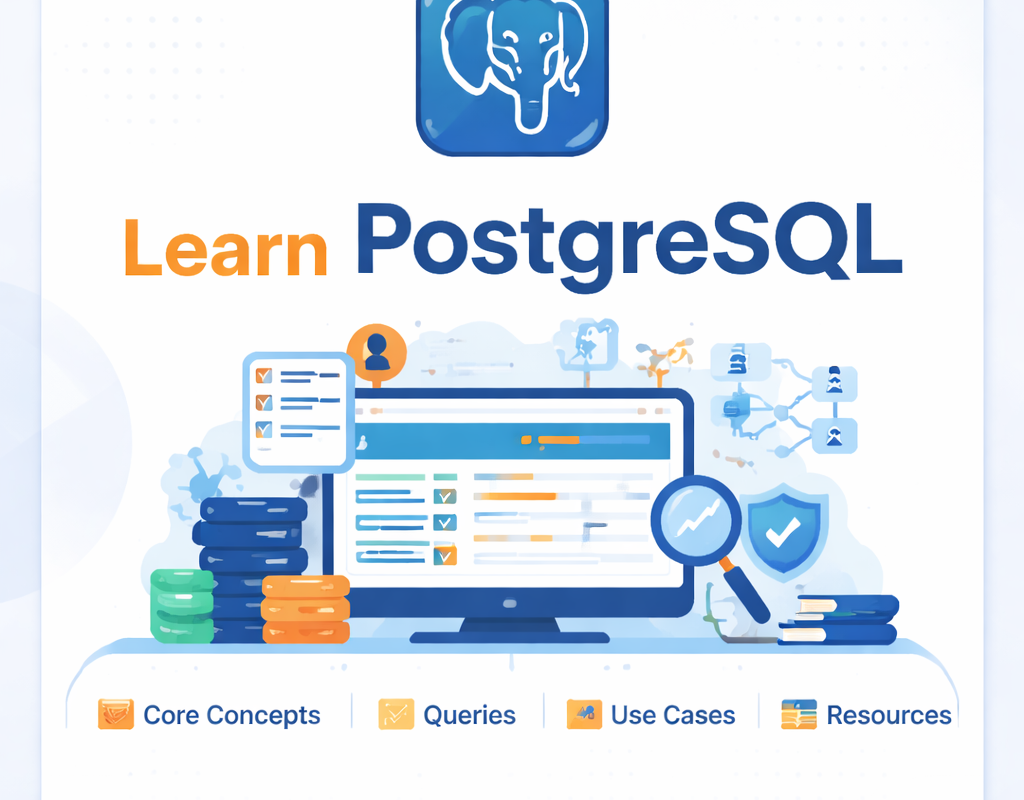
PostgreSQL for beginners is a powerful guide to learning how to manage databases, write SQL queries, and understand relational database concepts from scratch.PostgreSQL is one of the most advanced, reliable, and widely used open-source database systems in modern software development. It is designed to store, manage, and retrieve data efficiently while supporting complex queries and large-scale applications.
In today’s web development ecosystem, PostgreSQL is commonly used in backend systems, APIs, analytics platforms, and enterprise applications because of its stability, flexibility, and strong community support.This PostgreSQL for beginners guide will help you understand core concepts step by step.
Learn how full-stack applications are built using modern technologies in our MERN Stack blog.
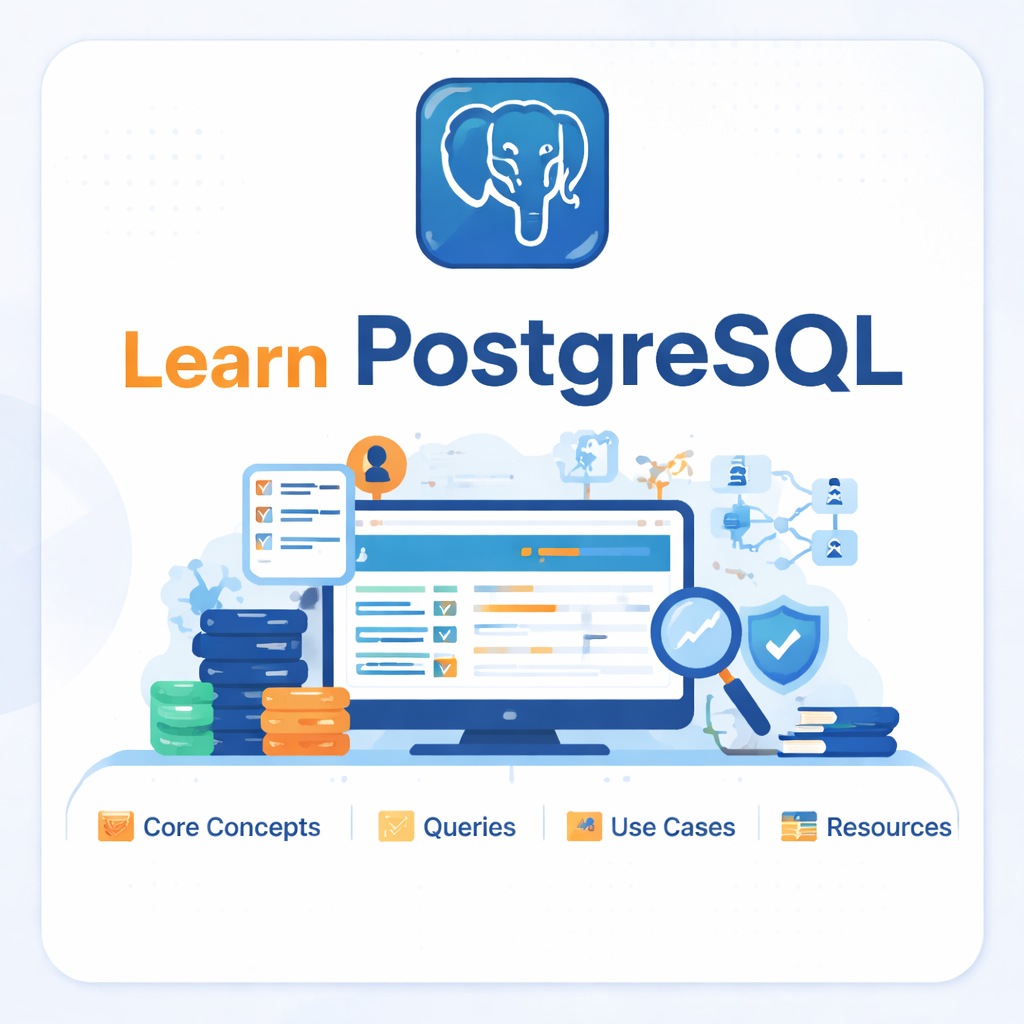
PostgreSQL for beginners: What is PostgreSQL?
PostgreSQL is an object-relational database management system (ORDBMS). It uses SQL (Structured Query Language) to interact with data.
Unlike simple databases, PostgreSQL supports:
- Structured data (tables)
- Semi-structured data (JSON)
- Advanced relationships between data
- Custom functions and extensions
PostgreSQL for beginners Key Features
PostgreSQL is known for its powerful features:
- Open-source: Free to use and modify
- ACID compliant: Ensures reliable transactions
- Highly scalable: Handles large datasets efficiently
- Extensible: Supports plugins, custom functions, and extensions
- Advanced data types: Includes JSON, arrays, and more
- Concurrency support: Multiple users can access data simultaneously
- Strong indexing system: Improves query performance
PostgreSQL Advantages (Detailed)
PostgreSQL provides several advantages over many databases:
- High reliability and stability
- Supports complex queries and joins
- Handles large datasets efficiently
- Strong data integrity with ACID compliance
- Supports both SQL and JSON data
- Highly extensible with plugins
- Works well with modern frameworks
PostgreSQL Limitations (Honest Section)
Adding limitations makes your blog more professional:
- Slightly complex for beginners
- Requires optimization for very large systems
- Setup and configuration can be tricky
- Performance tuning needed in some cases
Why PostgreSQL is Popular
PostgreSQL for beginners is easy to understand because it is widely used and well documented.
PostgreSQL is widely adopted because:
- It provides high data integrity
- It is suitable for complex applications
- It works well with modern frameworks like Node.js, Django, and Spring Boot
- It supports both small and enterprise-level systems
- It has excellent documentation and community support
PostgreSQL Architecture (Simple Overview)
PostgreSQL follows a client-server architecture:
- Client → Sends requests (applications or users)
- Server → Processes queries and logic
- Database Storage → Stores actual data on disk
This architecture allows multiple users and applications to interact with the database efficiently at the same time.
Core Concepts of PostgreSQL
1. Database
A database is a structured collection of data stored electronically.
2. Table
Tables are used to store data in rows and columns. Each row represents a record, and each column represents a field.
3. Schema
A schema defines the structure and organization of database objects such as tables and relationships.
4. Data Types
PostgreSQL supports various data types:
- Numeric (Integer, Float)
- Text (VARCHAR, TEXT)
- Boolean
- Date & Time
- JSON / JSONB
How PostgreSQL Works
The workflow of PostgreSQL is simple:
- A user sends a request from an application
- The request is sent to the PostgreSQL server
- The server processes the query
- Data is retrieved or modified in storage
- The result is returned to the application
This process ensures efficient communication between frontend, backend, and database.
Working with PostgreSQL
Instead of focusing too much on syntax, understanding concepts is important:
- Creating structures defines how data is organized
- Inserting data adds new records
- Retrieving data allows filtering and viewing
- Updating data modifies existing records
- Deleting data removes unwanted records
These operations form the foundation of database-driven applications.
Relationships and Joins
PostgreSQL supports relationships between tables using joins.
Joins allow combining related data from multiple tables into a single result.
Common join types include:
- INNER JOIN
- LEFT JOIN
- RIGHT JOIN
- FULL JOIN
These are essential when working with relational databases.
Indexing in PostgreSQL
Indexes improve query performance by allowing the database to quickly locate data without scanning the entire table.
This is especially useful when working with large datasets, where performance matters significantly.
Transactions and Data Integrity
PostgreSQL ensures that operations remain consistent using transactions.
A transaction is a set of operations that must either:
- Complete fully, or
- Fail completely
This is based on ACID properties:
- Atomicity
- Consistency
- Isolation
- Durability
These properties ensure reliable and safe data handling.
Real-World Use Cases
PostgreSQL is used in many industries and applications:
- E-commerce platforms (orders, products, users)
- Banking systems (transactions and accounts)
- Social media platforms (user data, posts)
- SaaS applications (multi-user systems)
- Data analytics and reporting systems
- Backend APIs for web and mobile apps
PostgreSQL vs Other Databases (Overview)
- PostgreSQL → Best for complex queries and structured data
- MySQL → Simpler, widely used for basic applications
- MongoDB → NoSQL database with flexible schema
PostgreSQL is preferred when data integrity, advanced querying, and scalability are important.
Learning Resources
To learn PostgreSQL in more depth, you can refer to the following trusted resources:
Official Documentation
Official PostgreSQL documentation provides detailed and accurate information about all features and concepts.
👉https://www.postgresql.org/docs/
Beginner Tutorial
W3Schools provides simple explanations and examples for beginners.
👉https://www.w3schools.com/postgresql/
Conclusion
PostgreSQL is a powerful and flexible database system that plays a crucial role in modern application development. It is suitable for beginners as well as professionals due to its advanced features and scalability.
By understanding its concepts, architecture, and usage patterns, you can build strong backend systems and work effectively with real-world applications.