 by
by Introduction
In today’s cybersecurity landscape, attacks are faster, stealthier, and more automated than ever before. Traditional security tools alone are no longer enough to detect modern threats in real time. This is where Advanced Log Monitoring becomes a critical defense layer for enterprises, cloud systems, and web applications.
Every system—from servers and APIs to firewalls and applications—generates logs. These logs contain valuable security signals such as login attempts, privilege changes, API failures, malware traces, and suspicious network activity. However, without proper monitoring, this data remains unused noise.
Advanced Log Monitoring transforms raw logs into actionable threat intelligence, enabling organizations to detect, analyze, and respond to cyber threats instantly. Modern cybersecurity frameworks strongly recommend continuous log monitoring for threat detection as defined by MITRE ATT&CK knowledge base.
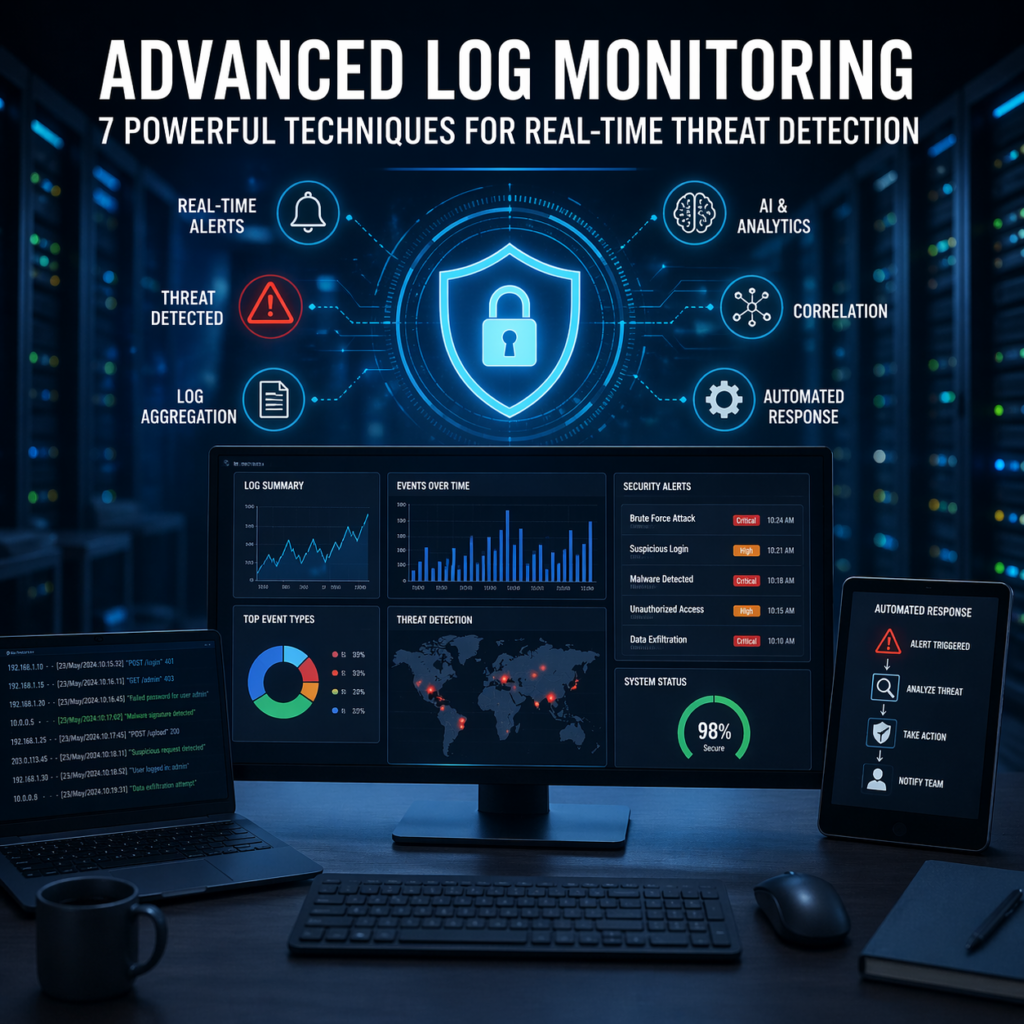
In this comprehensive guide, you’ll learn 7 powerful techniques for real-time threat detection using advanced log monitoring systems.
Why Advanced Log Monitoring Matters in Cybersecurity
In today’s digital infrastructure, Advanced Log Monitoring is essential for identifying attack patterns before they escalate into full-scale breaches.
Modern cyberattacks don’t happen in a single step. Attackers often follow a pattern:
- Reconnaissance (scanning systems)
- Initial access (phishing, brute force, exploit)
- Privilege escalation
- Lateral movement
- Data exfiltration
Each step leaves behind traces in logs.
Without advanced monitoring:
- Threats remain undetected for days or weeks
- Attack patterns go unnoticed
- Incident response becomes delayed and costly
With Advanced Log Monitoring, organizations gain:
- Real-time threat detection
- Faster incident response
- Improved compliance (ISO 27001, GDPR, SOC2)
- Reduced breach impact
7 Powerful Techniques for Real-Time Threat Detection
1. Centralized Log Aggregation (SIEM-Based Architecture)
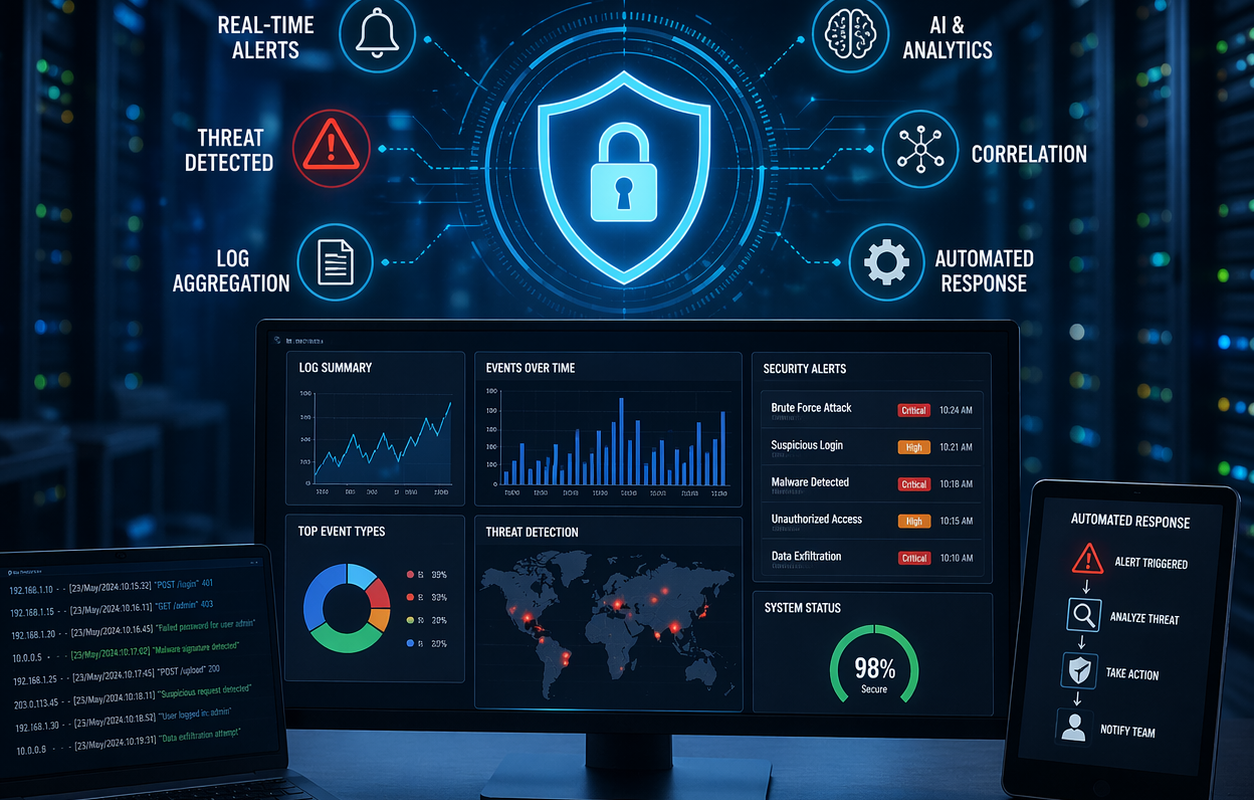
One of the core pillars of Advanced Log Monitoring is centralized log aggregation using a SIEM (Security Information and Event Management) system.
Instead of storing logs in isolated systems, logs are collected into a single platform from:
- Servers (Linux/Windows)
- Cloud platforms (AWS, Azure, GCP)
- Firewalls and IDS/IPS
- Applications and APIs
- Databases
Why It Matters
Centralization enables:
- Unified visibility across infrastructure
- Faster correlation of events
- Easier forensic investigations
How It Works
- Log agents collect data from endpoints
- Logs are forwarded to a central SIEM
- Data is indexed and stored in real time
- Security teams analyze everything from one dashboard
Example Threat Detection
A login failure on one server + privilege escalation on another = possible brute force attack chain.
2. Real-Time Log Streaming and Processing
Traditional log analysis is batch-based, which creates delays. Real-time log streaming solves this problem by processing logs as soon as they are generated. Real-time threat detection improves when applied with web application VAPT guide.
Technologies used:
- Apache Kafka
- Elasticsearch streaming pipelines
- Fluentd / Logstash
- Cloud-native streaming tools
Benefits
- Instant detection of suspicious activities
- Lower dwell time for attackers
- Continuous monitoring without delay
Use Case
If multiple failed SSH login attempts occur within seconds, the system immediately triggers an alert or blocks the IP.
Key Advantage
Real-time streaming ensures that threat detection happens within seconds, not hours.
3. AI and Machine Learning-Based Anomaly Detection
Modern Advanced Log Monitoring systems use AI and machine learning to detect unusual patterns that traditional rule-based systems cannot identify.
How It Works
Machine learning models analyze:
- Normal user behavior patterns
- Network traffic baselines
- Application usage trends
Then they flag deviations such as:
- Unusual login locations
- Abnormal data transfers
- Unexpected API usage spikes
Example
If a user normally logs in from India but suddenly logs in from multiple foreign IPs within minutes, the system flags it as suspicious.
Benefits
- Detects zero-day attacks
- Reduces false positives over time
- Learns continuously from new data
4. Log Correlation and Event Relationship Mapping
Attackers rarely trigger a single alert. They generate multiple small signals across systems.
Log correlation connects these signals into a single attack story.
Example Correlation Flow
- Firewall logs: blocked IP attempts
- Authentication logs: failed login attempts
- Application logs: unauthorized access attempt
Individually, these may seem harmless. Together, they indicate a brute force attack in progress.
Types of Correlation
- Time-based correlation
- Rule-based correlation
- Cross-system correlation
- Behavioral correlation
Why It Is Powerful
Correlation reduces noise and helps SOC teams focus only on meaningful threats.
5. Log Normalization and Intelligent Parsing
Logs come in different formats:
- JSON (APIs)
- Syslog (servers)
- Plain text (legacy systems)
- Cloud-native logs
Cloud environments need strong protection using cloud security best practices. Without normalization, analyzing them is extremely difficult.
What Log Normalization Does
It converts all logs into a standardized format like:
- Timestamp
- Source IP
- Event type
- User ID
- Action performed
Benefits
- Easier querying and searching
- Better correlation accuracy
- Improved dashboard visualization
Example
Instead of analyzing 10 different formats, all logs are transformed into a unified structure for analysis.
6. Integration with Threat Intelligence Feeds
Advanced Log Monitoring becomes significantly more powerful when integrated with threat intelligence feeds.
These feeds provide real-time data on:
- Known malicious IP addresses
- Malware signatures
- Phishing domains
- Botnet activity
How It Enhances Security
When logs show activity from a known malicious IP:
- System immediately flags it
- Automatic blocking can be triggered
- SOC teams receive high-priority alerts
Example
If a login attempt originates from a blacklisted IP in a threat database, it is instantly marked as a high-risk event.
Key Advantage
Transforms internal logs into global threat-aware intelligence systems.
7. Automated Alerting and SOAR-Based Response
Detection alone is not enough. Speed of response is critical.
This is where SOAR (Security Orchestration, Automation, and Response) comes in.
What Happens in SOAR-Enabled Log Monitoring
When a threat is detected:
- Alert is generated instantly
- Playbook is triggered automatically
- Response actions are executed:
- Block IP address
- Disable compromised account
- Isolate affected server
- Incident is logged for forensic review
Benefits
- Reduces manual intervention
- Speeds up incident response
- Minimizes damage from attacks
Example Scenario
If ransomware behavior is detected in logs:
- System isolates the endpoint
- Network access is restricted
- Security team is alerted immediately
Advanced Log Monitoring Architecture Overview
A modern architecture typically includes:
- Data sources (servers, apps, cloud)
- Log collectors (agents)
- Streaming pipeline (Kafka/Fluentd)
- SIEM platform
- AI/ML detection engine
- Threat intelligence integration
- SOAR automation layer
This layered approach ensures end-to-end visibility and automation.
Real-World Use Cases of Advanced Log Monitoring
1. Cloud Security Monitoring
Detect misconfigured cloud storage, unauthorized API calls, and privilege escalation.
2. Web Application Security
Identify SQL injection attempts, XSS patterns, and suspicious API traffic.
3. Insider Threat Detection
Track unusual employee behavior like unauthorized data downloads.
4. Ransomware Detection
Detect file encryption patterns and abnormal system activity.
Challenges in Log Monitoring
Even advanced systems face challenges:
- Massive log volume (big data problem)
- High false positive rates
- Storage and cost issues
- Complex multi-cloud environments
Solution
AI-driven filtering + scalable cloud log pipelines help overcome these challenges.
Best Practices for Implementation
To maximize effectiveness:
- Enable centralized logging from day one
- Use structured logging formats (JSON preferred)
- Apply strict role-based access controls
- Regularly update threat intelligence feeds
- Tune detection rules frequently
- Combine AI + rule-based systems
FAQ
What is Advanced Log Monitoring?
It is a cybersecurity approach that collects, analyzes, and correlates logs in real time to detect threats instantly.
Why is real-time log monitoring important?
Because cyberattacks happen quickly, and delayed detection increases damage.
Is SIEM necessary for log monitoring?
Yes, SIEM platforms are essential for centralized analysis and correlation.
Can AI improve log monitoring?
Yes, AI helps detect unknown threats and reduces false positives significantly.
Conclusion
Advanced Log Monitoring is no longer optional—it is a fundamental cybersecurity requirement for modern organizations.
By combining:
- Centralized log aggregation
- Real-time streaming
- AI-driven anomaly detection
- Log correlation
- Normalization
- Threat intelligence integration
- Automated SOAR response
organizations can build a powerful real-time defense system against evolving cyber threats.
In a world where attackers operate in seconds, your defense must operate in real time.