 by
by Introduction
IT Service Management Framework is becoming a critical foundation for modern businesses that want to improve efficiency, reduce downtime, and manage IT operations effectively. As organizations scale, managing IT services efficiently becomes critical to maintaining productivity, reducing downtime, and ensuring seamless user experience. This is where an IT Service Management (ITSM) framework plays a vital role.
An ITSM framework is a structured approach that helps organizations design, deliver, manage, and improve IT services aligned with business goals. In modern enterprises, ITSM is no longer just about ticket resolution—it has evolved into a strategic enabler of digital transformation, operational resilience, and cost optimization.
With the rise of AI-driven operations, hybrid cloud environments, cybersecurity threats, and remote work models, the ITSM framework in 2025 has become more intelligent, automated, and business-centric than ever before.
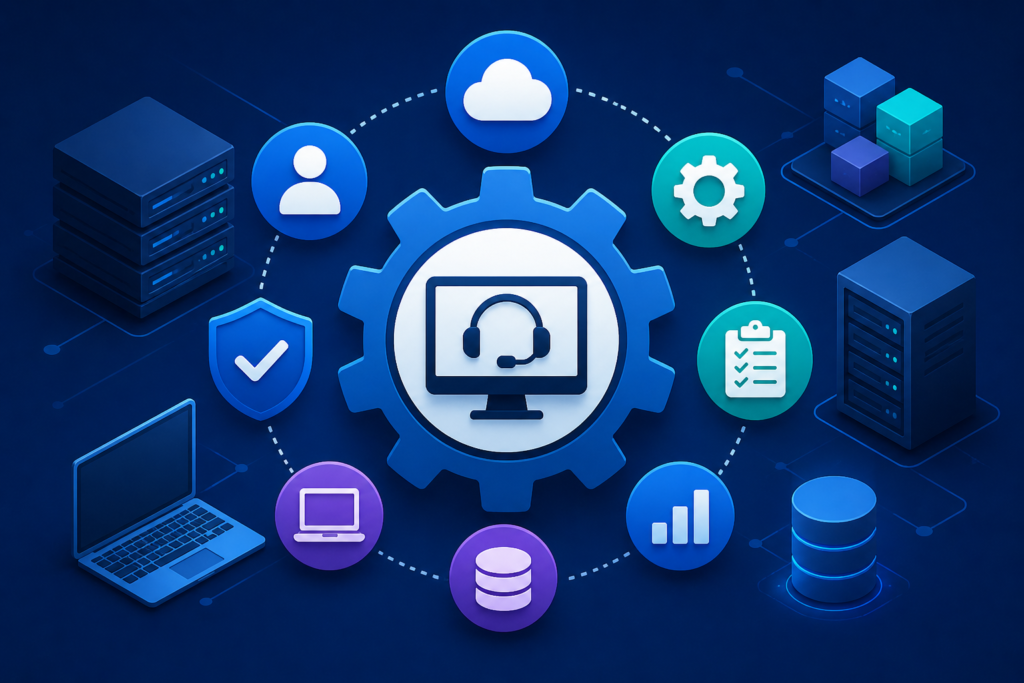
What is IT Service Management (ITSM)?
IT Service Management refers to the set of processes and practices used to manage IT services throughout their lifecycle—from planning and design to delivery, support, and continuous improvement.
Unlike traditional IT support, ITSM focuses on:
- Aligning IT services with business objectives
- Improving service quality and user satisfaction
- Automating repetitive IT operations
- Ensuring consistent service delivery
- Reducing operational costs and downtime
In 2025, ITSM frameworks are heavily integrated with AI, machine learning, and cloud-native architectures.
Importance of ITSM Framework
The IT Service Management Framework plays a key role in improving operational efficiency in modern enterprises. A modern ITSM framework is essential for businesses due to the increasing complexity of IT environments.
Just like Network Segmentation Strategies, the IT Service Management Framework improves security and operational control.
1. Business-IT Alignment
ITSM ensures that IT operations directly support business goals such as revenue growth, customer experience, and scalability.
2. Operational Efficiency
Automation of incident management, service requests, and change management significantly reduces manual workload.
3. Faster Incident Resolution
AI-powered ticketing systems help identify, categorize, and resolve issues faster than traditional systems.
4. Cost Optimization
Efficient resource allocation and automation reduce unnecessary IT spending.
5. Enhanced Security and Compliance
ITSM frameworks integrate with cybersecurity systems to ensure compliance with standards and reduce risks.
Core ITSM Framework Components
Modern ITSM frameworks are built on several key components that ensure smooth IT service delivery.
1. Incident Management
This process focuses on restoring normal service operations as quickly as possible after an interruption.
The IT Service Management Framework ensures all IT processes are standardized and measurable.
Key Features:
- Automated ticket classification
- AI-based root cause analysis
- Self-healing systems
2. Problem Management
Problem management identifies the root cause of recurring incidents and prevents future disruptions.
3. Change Management
Ensures that IT changes are implemented with minimal risk and disruption to services.
Modern Enhancements:
- Predictive impact analysis
- Automated approval workflows
- Risk scoring systems
4. Service Request Management
Handles user requests such as software installation, access permissions, and hardware provisioning.
5. Knowledge Management
Centralized knowledge bases allow faster problem resolution and empower self-service portals.
6. Configuration Management (CMDB)
A Configuration Management Database (CMDB) tracks IT assets and their relationships for better visibility and control.
Modern ITSM Framework Models
In a modern enterprise model, the IT Service Management Framework integrates cloud-native services and AI automation for faster decision-making.
Several frameworks and methodologies define how ITSM is implemented.
1. ITIL 4 (Information Technology Infrastructure Library)
ITIL 4 remains the most widely adopted ITSM framework. It emphasizes value streams, agility, and continuous improvement.
Key Features:
- Service Value System (SVS)
- Four dimensions of service management
- Agile and DevOps integration
2. COBIT Framework
COBIT framework focuses on governance and management of enterprise IT.
Key Benefits:
- Strong compliance control
- Risk management alignment
- Governance-driven IT strategy
3. DevOps Integration Model
DevOps combines development and IT operations for faster and more reliable software delivery.
4. Agile ITSM
Agile ITSM focuses on flexibility, iterative improvements, and rapid service delivery.
AI and Automation in ITSM
AI is transforming the IT Service Management Framework by enabling predictive and automated IT operations. AI has transformed ITSM from reactive support to predictive and proactive service management.
AI-driven IT operations, similar to Edge AI in 2025, are transforming the IT Service Management Framework.
1. AI-Powered Chatbots
Virtual agents handle common IT issues without human intervention.
2. Predictive Analytics
AI predicts system failures before they occur, reducing downtime.
3. Automated Ticket Routing
Machine learning models automatically assign tickets to the right teams.
4. Self-Healing Infrastructure
Systems automatically detect and fix minor issues without human input.
Benefits of ITSM Framework for Business Efficiency
The IT Service Management Framework improves business efficiency by reducing downtime and optimizing resources.
A well-implemented ITSM framework delivers measurable business advantages.
1. Improved Productivity
Employees spend less time waiting for IT support and more time on core tasks.
2. Better Customer Experience
Faster service resolution leads to higher satisfaction levels.
3. Reduced Downtime
Proactive monitoring prevents system outages.
4. Data-Driven Decision Making
ITSM dashboards provide actionable insights into IT performance.
5. Scalability
Supports business growth without increasing operational complexity.
Challenges in ITSM Implementation
Implementing the IT Service Management Framework can be challenging due to integration and skill gaps.
Despite its advantages, ITSM implementation comes with challenges.
1. Cultural Resistance
Employees may resist adopting new IT processes.
2. Integration Complexity
Integrating ITSM tools with legacy systems can be difficult.
3. High Initial Investment
Advanced ITSM platforms require significant upfront cost.
4. Skill Gaps
Organizations need skilled professionals to manage ITSM tools effectively.
Best Practices for ITSM
A strong IT Service Management Framework requires automation of repetitive IT support tasks.
To maximize ITSM efficiency, organizations should follow these best practices:
1. Focus on Automation First
Automate repetitive tasks to improve speed and accuracy.
2. Adopt Cloud-Based ITSM Tools
Cloud platforms provide scalability and flexibility.
3. Integrate AI and Analytics
Use predictive insights for proactive IT management.
4. Implement Continuous Improvement
Regularly evaluate and improve IT processes.
5. Strengthen Security Integration
Combine ITSM with cybersecurity frameworks for better protection.
Future of ITSM Framework
The future of ITSM is evolving rapidly with advanced technologies.
1. Hyperautomation
Complete automation of IT workflows using AI and RPA.
2. Autonomous IT Operations
Self-managing IT systems with minimal human intervention.
3. Digital Employee Experience (DEX)
Focus on improving employee satisfaction through seamless IT services.
4. Unified Service Management Platforms
Single platforms managing IT, HR, and business services together.
Conclusion
The IT Service Management framework in 2025 is no longer just a support system—it is a strategic business enabler. With the integration of AI, automation, cloud computing, and advanced analytics, ITSM has become a core driver of business efficiency, agility, and resilience.
Organizations that adopt modern ITSM frameworks gain a competitive advantage through faster service delivery, reduced operational costs, and improved customer satisfaction. As digital transformation accelerates, ITSM will continue to evolve into a fully autonomous, intelligent service ecosystem. The IT Service Management Framework is essential for achieving scalable and efficient IT operations.