 by
by Introduction
Edge AI in 2025 is changing how businesses process data in real time. Traditional cloud-based AI systems often struggle with latency, bandwidth limitations, and privacy risks. Edge AI solves these problems by moving artificial intelligence closer to the data source.
From IoT devices and smart factories to healthcare systems and autonomous vehicles, Edge AI enables faster processing, better security, and improved efficiency.
As businesses generate massive amounts of real-time data, Edge AI has become essential for intelligent automation and instant decision-making.
In this guide, we will explore the 7 powerful use cases of Edge AI, its benefits, challenges, and why it is becoming the backbone of modern IT infrastructure.
What is Edge AI?
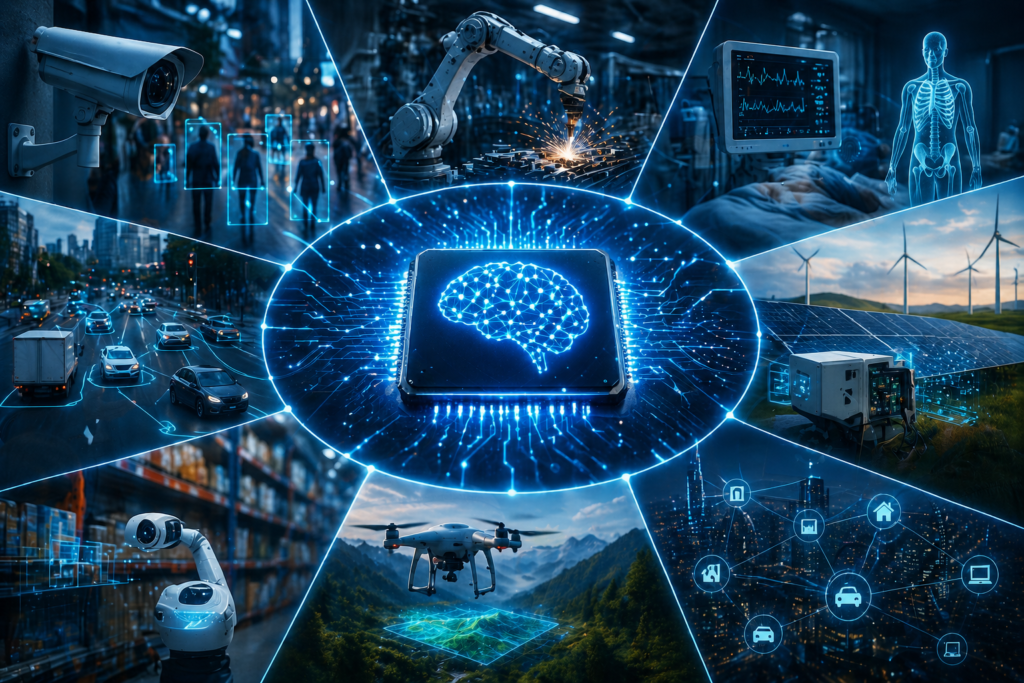
Edge AI in 2025 refers to deploying AI algorithms directly on edge devices such as sensors, cameras, smartphones, industrial machines, and IoT systems. Edge AI allows intelligent systems to analyze data locally without depending entirely on cloud servers.
Instead of sending data to the cloud for analysis, Edge AI processes data locally.
This enables:
- Faster response times
- Reduced bandwidth usage
- Better privacy protection
- Real-time analytics
- Lower cloud dependency
Edge AI combines:
- Artificial Intelligence
- Machine Learning
- Edge Computing
- IoT Infrastructure
This integration makes Edge AI one of the most important technologies for modern enterprises.
Why Edge AI Matters
Edge AI in 2025 improves real-time decision-making by processing data closer to the source. Businesses now require instant insights.
Cloud-only AI systems create challenges:
| Traditional Cloud AI | Edge AI |
| High latency | Ultra-low latency |
| Bandwidth heavy | Reduced bandwidth |
| Privacy risks | Better data privacy |
| Internet dependent | Offline capabilities |
| Slower decision-making | Real-time intelligence |
With increasing IoT adoption, Edge AI helps businesses make decisions faster and more securely.
7 Powerful Use Cases of Edge AI
The growing adoption of Edge AI across industries is improving automation, speed, and decision-making.
1. Smart Manufacturing and Predictive Maintenance
Manufacturing is one of the biggest adopters of Edge AI.
Edge AI in 2025 is helping manufacturers improve predictive maintenance and reduce downtime.
Industrial machines generate huge amounts of operational data.
Edge AI helps detect anomalies instantly.
Benefits:
- Predict equipment failure
- Reduce downtime
- Improve machine efficiency
- Real-time defect detection
Edge AI in 2025 helps manufacturers detect machine failures before major downtime occurs.
Example:
AI-powered sensors monitor machine vibration and temperature.
If abnormal behavior is detected, maintenance alerts trigger immediately.
This reduces production loss.
2. Autonomous Vehicles
Self-driving systems require instant decision-making. .
Sending data to cloud servers creates dangerous delays. Edge AI enables autonomous vehicles to process road conditions instantly.
Edge AI processes:
- Road conditions
- Object detection
- Pedestrian movement
- Traffic signals
in milliseconds.
Benefits:
- Faster navigation decisions
- Reduced accident risk
- Improved route optimization
Autonomous systems rely heavily on Edge AI for safety.
3. Smart Surveillance Systems
Traditional surveillance stores video but lacks intelligent processing.
Edge AI adds real-time video intelligence.
Capabilities include:
- Face recognition
- Suspicious activity detection
- Unauthorized access alerts
- Vehicle identification
Benefits:
- Faster threat detection
- Lower storage costs
- Better privacy compliance
Businesses use Edge AI for stronger physical security.
4. Healthcare Monitoring Systems
Healthcare needs immediate response systems. Edge AI in 2025 is improving healthcare monitoring by enabling faster patient data analysis.
Edge AI in medical devices enables:
- Real-time patient monitoring
- Heart rate analysis
- Emergency detection
- Wearable health tracking
Benefits:
- Faster emergency alerts
- Better patient care
- Lower hospital workload
Example devices:
- Smart ECG monitors
- AI wearables
- Smart insulin systems
Edge AI improves healthcare efficiency.
5. Retail Customer Analytics
Retail stores use Edge AI for smarter customer experiences. Retail businesses are using Edge AI in 2025 to understand customer behavior in real time.
AI cameras analyze:
- Customer movement
- Product interaction
- Queue length
- Shopping behavior
Benefits:
- Personalized offers
- Better inventory planning
- Improved customer satisfaction
Retail analytics improve sales performance.
6. Smart Cities and Traffic Management
Cities generate large-scale real-time traffic data. Edge AI in 2025 is helping smart cities optimize traffic flow and public safety systems.
Edge AI processes:
- Traffic congestion
- Accident detection
- Parking management
- Public safety monitoring
Benefits:
- Reduced traffic congestion
- Better road safety
- Efficient urban management
Smart cities depend on Edge AI for automation.
7. Industrial IoT Security
IoT devices are vulnerable to cyberattacks, making API Security in Cloud-Native Applications critical for protecting connected environments.
Edge AI strengthens IoT security by identifying suspicious activity in real time. Edge AI in 2025 helps detect suspicious behavior locally.
Security capabilities:
- Device anomaly detection
- Threat intelligence
- Access pattern monitoring
- Malware detection
Benefits:
- Faster threat detection
- Better network security
- Lower breach impact
Edge AI improves industrial cybersecurity.
Core Benefits of Edge AI
Faster Data Processing
Local processing reduces delays.
Real-time decisions become possible.
Reduced Bandwidth Usage
Only useful data gets sent to cloud.
This reduces network traffic.
Better Privacy
Sensitive data stays local.
Improves compliance.
Lower Operational Costs
Reduced cloud storage and bandwidth costs.
Improves ROI.
Improved Reliability
Works even with poor internet.
Useful in remote areas.
Challenges of Edge AI
Hardware Limitations
Edge devices have limited resources.
AI models must be optimized.
Security Risks
Distributed devices increase attack surfaces.
Security measures are essential.
Model Management
Updating AI models across many devices is difficult.
Centralized management helps.
Data Consistency
Multiple devices create fragmented data.
Synchronization is important.
Best Practices for Edge AI Implementation
Choose Lightweight AI Models
Optimize for edge devices.
Examples:
Secure Edge Devices
Implement:
- Device encryption
- Authentication
- Firmware security
Monitor Device Performance
Track:
- CPU usage
- Memory
- Temperature
Regular monitoring improves performance.
Combine Edge + Cloud
Hybrid architecture offers best performance.
Use edge for speed.
Use cloud for deep analysis.
Future of Edge AI
The future of Edge AI depends on faster processors, smarter models, and wider IoT adoption.
Edge AI in 2025 is helping businesses improve automation and real-time intelligence. The growth of Edge AI in 2025 is accelerating because of IoT expansion and faster AI chips.
Edge AI will continue growing because:
- IoT expansion is increasing
- 5G adoption improves connectivity
- AI chips are becoming powerful
- Real-time automation demand is rising
Industries like healthcare, finance, manufacturing, and cybersecurity will rely heavily on Edge AI.
The future is decentralized intelligence.
FAQs
Is Edge AI better than Cloud AI?
Edge AI is better for real-time processing and low-latency applications.
Cloud AI is better for large-scale training.
Is Edge AI secure?
Yes, if proper encryption and authentication are implemented.
Which industries use Edge AI most?
Healthcare, manufacturing, retail, transportation, and cybersecurity.
Does Edge AI reduce cloud costs?
Yes, local processing reduces cloud bandwidth and storage expenses.
Conclusion
Edge AI in 2025 is transforming how organizations process data.
Edge AI in 2025 will continue driving innovation in healthcare, manufacturing, and smart infrastructure.
By bringing AI closer to data sources, businesses gain:
- Faster decisions
- Better privacy
- Lower latency
- Improved security
- Better operational efficiency
From autonomous vehicles to industrial security, Edge AIin 2025 is powering the future of intelligent systems. Edge AI will continue shaping the future of intelligent automation.
Organizations adopting Edge AI today will gain a major competitive advantage in tomorrow’s digital world.