
 by
by Introduction
Low-Code Development Platforms are rapidly changing the software development landscape in 2025. Organizations today are under constant pressure to deliver digital products faster, reduce development costs, and improve scalability without compromising quality.
Traditional development methods require skilled programmers, long development cycles, complex testing, and deployment pipelines. This slows down innovation and increases time-to-market.
Low-code platforms solve this problem by enabling developers and even non-technical users to build applications using visual interfaces, drag-and-drop tools, reusable components, and minimal hand coding.
Modern platforms such as Microsoft Power Apps, OutSystems, Mendix, and Appian are powering enterprise-grade applications across industries like finance, healthcare, retail, and logistics.
In this blog, we will explore the 7 powerful benefits of Low-Code Development Platforms and why they are becoming a key part of modern digital transformation strategies. Low-Code Development Platforms are widely used in modern application development for faster delivery.
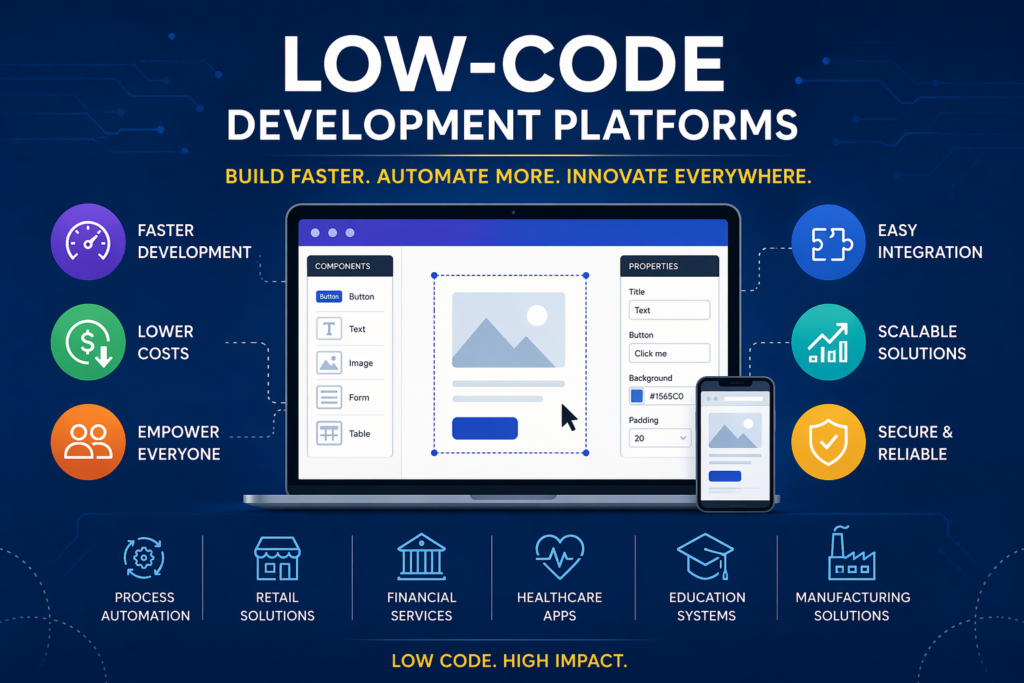
7 Powerful Benefits of Low-Code Development Platforms
Low-Code Development Platforms help businesses reduce development time and improve efficiency.
1. Faster Application Development Speed
Low-code platforms significantly reduce the time required to build applications.
Instead of writing thousands of lines of code, developers can use pre-built modules, templates, and visual workflows.
This enables rapid prototyping and faster development cycles.
Businesses can turn ideas into functional applications within days or weeks instead of months.
This speed advantage is critical in competitive markets where early product launches often determine success.
2. Reduced Development Costs
One of the biggest advantages of low-code development is cost efficiency.
Companies can reduce dependency on large development teams, lowering hiring and operational costs.
Reusable components eliminate redundant coding efforts, further reducing development time and cost.
This makes low-code platforms especially valuable for startups and small businesses with limited budgets.
Even large enterprises benefit by optimizing resource allocation.
3. Easy Integration with Existing Systems
Modern applications need to interact with multiple systems like APIs, databases, CRMs, and cloud services.
Low-code platforms provide built-in connectors and integration tools that simplify this process.
They can easily integrate with:
- Cloud services
- REST APIs
- Enterprise systems (ERP, CRM)
- Third-party tools
This ensures seamless data flow across systems without complex backend coding.
4. Improved Collaboration Between Teams
Low-code platforms bridge the gap between business teams and IT teams.
Business analysts, designers, and developers can collaborate in real time using visual development tools.
This improves communication, reduces misunderstandings, and ensures that business requirements are accurately implemented.
It also enables “citizen developers” to contribute to application development, increasing productivity across the organization.
5. Enhanced Scalability and Flexibility
Modern low-code platforms are built to support enterprise-level scalability.
They use cloud infrastructure, microservices architecture, and modular components to ensure applications can grow with business needs.
As user demand increases, applications can be scaled without major redesign or redevelopment.
This flexibility makes low-code suitable for both small applications and large enterprise systems.
6. Faster Time-to-Market
In today’s digital economy, speed is a major competitive advantage.
Low-code platforms help businesses launch products faster by reducing development cycles.
Companies can quickly build MVPs (Minimum Viable Products), test market response, and improve based on user feedback.
This agile development approach reduces risk and increases innovation speed.
7. Reduced Dependency on Skilled Developers
Low-code platforms reduce the need for highly specialized programming skills.
Simple applications can be built by semi-technical users using visual tools.
Experienced developers can then focus on complex logic, architecture, and performance optimization.
This improves workforce efficiency and helps organizations scale development without hiring large engineering teams.
Use Cases of Low-Code Development Platforms
Low-code platforms are widely used across industries for:
- Enterprise dashboards and reporting systems
- Customer relationship management (CRM) tools
- E-commerce applications
- Workflow automation systems
- Internal business applications
- Mobile and web app development
- Many organizations adopt Low-Code Development Platforms for automation and rapid deployment.
Challenges of Low-Code Platforms
Despite many advantages, low-code development also has some limitations:
- Limited customization for highly complex systems
- Vendor lock-in risk depending on platform
- Performance limitations for extremely large-scale systems
- Dependency on platform-specific features
However, most modern enterprises find these limitations manageable compared to the benefits.
Future of Low-Code Development
Future low-code platforms will also integrate AI DevOps automation for faster deployment cycles. Low-code development is evolving rapidly with AI integration and automation.
Future platforms are expected to include:
- AI-assisted application generation
- Auto code optimization and debugging
- Smarter UI/UX generation
- Stronger enterprise security features
- Better DevOps and CI/CD integration
Modern cloud systems also benefit from cloud cost optimization strategies when deploying low-code applications at scale. This evolution makes low-code a core pillar of digital transformation strategies.
Conclusion
Low-Code Development Platforms are becoming essential in modern software development ecosystems. Low-Code Development Platforms are revolutionizing software development in 2025. They help organizations build applications faster, reduce costs, improve collaboration, and scale efficiently.
With platforms like Microsoft Power Apps, OutSystems, Mendix, and Appian, businesses can accelerate digital transformation without heavy coding dependency.
In today’s fast-moving digital world, low-code is no longer just an option—it is a strategic necessity for innovation and growth.