
 by
by Introduction
Modern software systems are rapidly evolving toward distributed architectures, and microservices have become the backbone of scalable, resilient, and high-performance applications. Instead of building a single monolithic system, microservices break applications into small, independent services that communicate over APIs.
However, designing microservices is not just about splitting code—it requires strong architectural thinking. That’s where design patterns come in. They provide proven solutions to recurring problems in distributed systems like communication, data consistency, scalability, and fault tolerance.

What are Microservices Design Patterns?
Microservices Design Patterns are proven architectural solutions used to design and manage distributed systems effectively. These patterns help solve common challenges like communication between services, data consistency, scalability, and system reliability. Microservices Design Patterns are widely used in modern software architecture to solve distributed system challenges.
To understand modern distributed architecture in detail, read our guide on Microservices Architecture Patterns for Scalable Systems.
In simple terms, Microservices Design Patterns provide a structured way to build complex applications using independent and loosely coupled services.
7 Essential Microservices Design Patterns
1. API Gateway Pattern
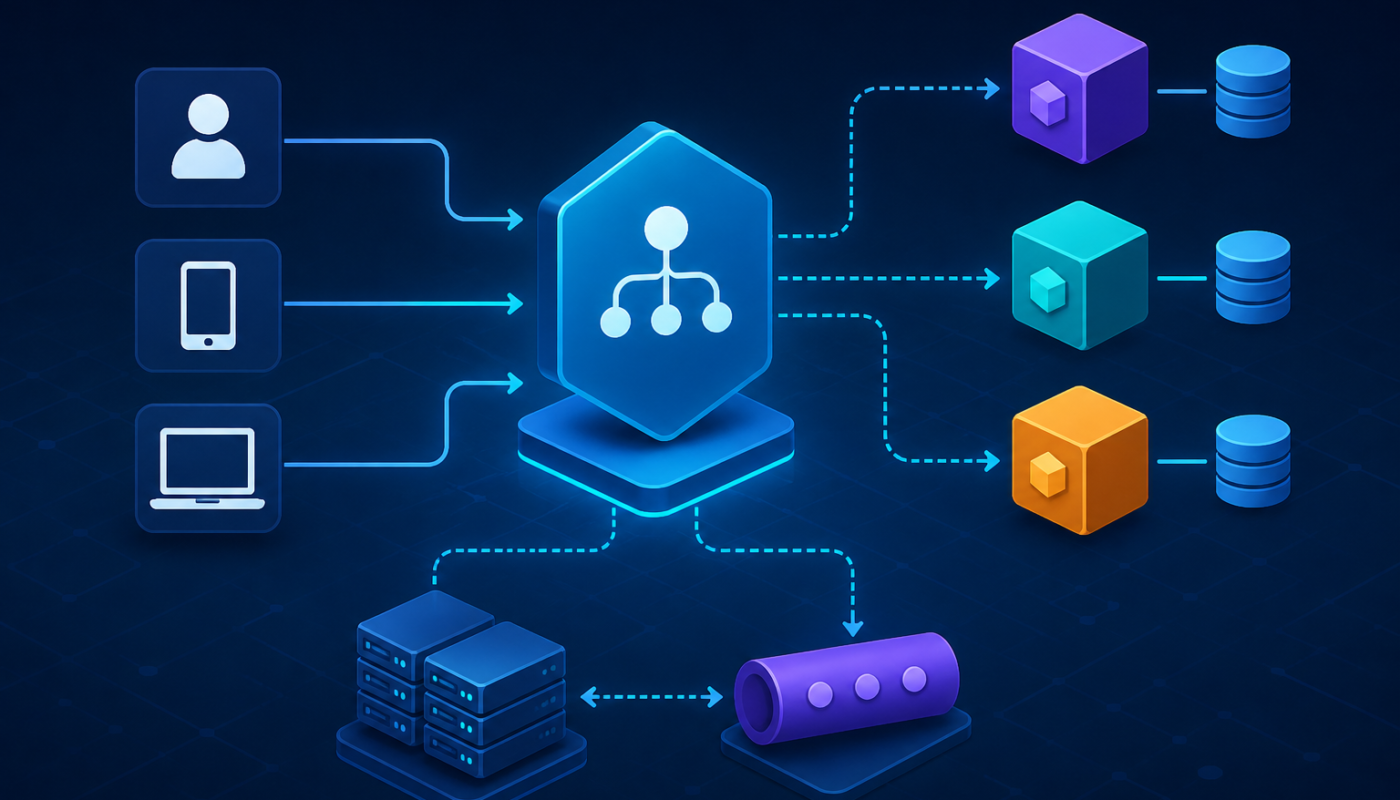
The API Gateway acts as a single entry point for all client requests in a microservices architecture.
Why it is important:
- Reduces complexity for clients
- Handles authentication and authorization
- Performs request routing to appropriate services
- Enables load balancing and caching
How it works:
Instead of clients calling multiple microservices directly, they interact with a single API Gateway. The gateway then routes requests to the correct backend service.
Benefits:
- Simplified client-side logic
- Centralized security management
- Better monitoring and logging
This is one of the most widely used Microservices Design Patterns in enterprise applications.
2. Database per Service Pattern
In microservices architecture, each service should manage its own database.
Why it is important:
- Prevents tight coupling between services
- Improves scalability and flexibility
- Allows different databases for different services
How it works:
Each microservice owns its data and database schema. Other services cannot directly access it.
Benefits:
- Independent deployment and scaling
- Better fault isolation
- Technology freedom (SQL, NoSQL, etc.)
This approach is a core part of Microservices Design Patterns for achieving loose coupling.
3. Circuit Breaker Pattern
This pattern prevents system failure when a service is not responding or is overloaded.
Why it is important:
- Avoids cascading failures
- Improves system stability
- Enhances fault tolerance
How it works:
If a service call fails repeatedly, the circuit breaker “opens” and stops requests temporarily. After a timeout, it allows limited requests to test recovery.
Benefits:
- Prevents system overload
- Faster failure detection
- Improved user experience
Microservices Design Patterns like Circuit Breaker improve system resilience significantly.
4. Event-Driven Architecture Pattern
This pattern uses events to communicate between microservices asynchronously. Modern distributed systems rely on event-driven systems for better scalability and real-time communication.
Why it is important:
- Reduces tight coupling
- Enables real-time processing
- Improves scalability
How it works:
Services publish events (like “Order Placed”), and other services subscribe to those events and react accordingly.
Benefits:
- Highly scalable systems
- Loose coupling between services
- Better responsiveness
This is a key Microservices Design Patterns strategy for modern distributed systems.
5. Saga Pattern
The Saga pattern manages distributed transactions across multiple microservices.
Why it is important:
- Maintains data consistency
- Handles failures in distributed transactions
- Avoids traditional two-phase commit complexity
How it works:
A saga breaks a transaction into smaller steps. If one step fails, compensating actions are triggered to rollback previous steps.
Types:
- Choreography-based saga
- Orchestration-based saga
Benefits:
- Reliable data consistency
- Scalable transaction handling
- Better fault recovery
6. Service Discovery Pattern
In microservices, services dynamically scale, making it difficult to track their locations. Service discovery solves this issue.
Why it is important:
- Enables dynamic service registration
- Eliminates hard-coded service URLs
- Improves system flexibility
How it works:
Services register themselves in a service registry. Other services query this registry to locate them.
Benefits:
- Automatic load balancing
- Easier scaling
- Improved system resilience
7. Bulkhead Pattern
The bulkhead pattern isolates system components to prevent total system failure.
Why it is important:
- Prevents resource exhaustion
- Limits failure impact
- Improves system reliability
How it works:
System resources (threads, connections) are divided into isolated pools. If one service fails, others remain unaffected.
Benefits:
- Fault isolation
- Better resource management
- Increased system stability
Benefits of Using Microservices Design Patterns
Implementing these patterns provides several advantages:
- Highly scalable architecture
- Improved fault tolerance
- Faster development cycles
- Independent deployment of services
- Better maintainability
These patterns ensure that distributed systems remain stable even under heavy load or partial failures.
Challenges in Microservices Design
While powerful, microservices also come with challenges:
- Complex system monitoring
- Network latency issues
- Data consistency management
- Debugging distributed systems
Using the right design patterns helps overcome these challenges effectively.
Future of Microservices Architecture
Microservices are evolving with cloud-native technologies like Kubernetes, serverless computing, and AI-driven automation. In the future, we will see:
- More intelligent service orchestration
- Automated scaling systems
- Stronger event-driven ecosystems
- AI-based system monitoring
Microservices will continue to dominate modern software architecture due to their flexibility and scalability.
FAQs
1. What are microservices design patterns?
Microservices design patterns are proven architectural solutions used to solve common problems in distributed systems such as communication, scalability, fault tolerance, and data consistency.
2. Why are microservices better than monolithic architecture?
Microservices offer better scalability, flexibility, and independent deployment. Unlike monolithic systems, each service can be developed and scaled separately.
3. What is the most important microservices pattern?
The API Gateway Pattern is often considered the most important because it acts as a single entry point for all client requests and simplifies system communication.
4. When should we use the Saga Pattern?
The Saga Pattern is used when you need to manage distributed transactions across multiple services while maintaining data consistency.
5. What is the role of Service Discovery in microservices?
Service Discovery automatically detects service locations in dynamic environments, eliminating the need for hardcoded URLs and improving scalability.
Conclusion
The 7 essential microservices design patterns—API Gateway, Database per Service, Circuit Breaker, Event-Driven Architecture, Saga, Service Discovery, and Bulkhead—form the foundation of robust distributed systems.
Understanding and implementing these patterns helps developers build systems that are scalable, resilient, and production-ready.
If you are designing modern applications, mastering these patterns is not optional—it is essential.