
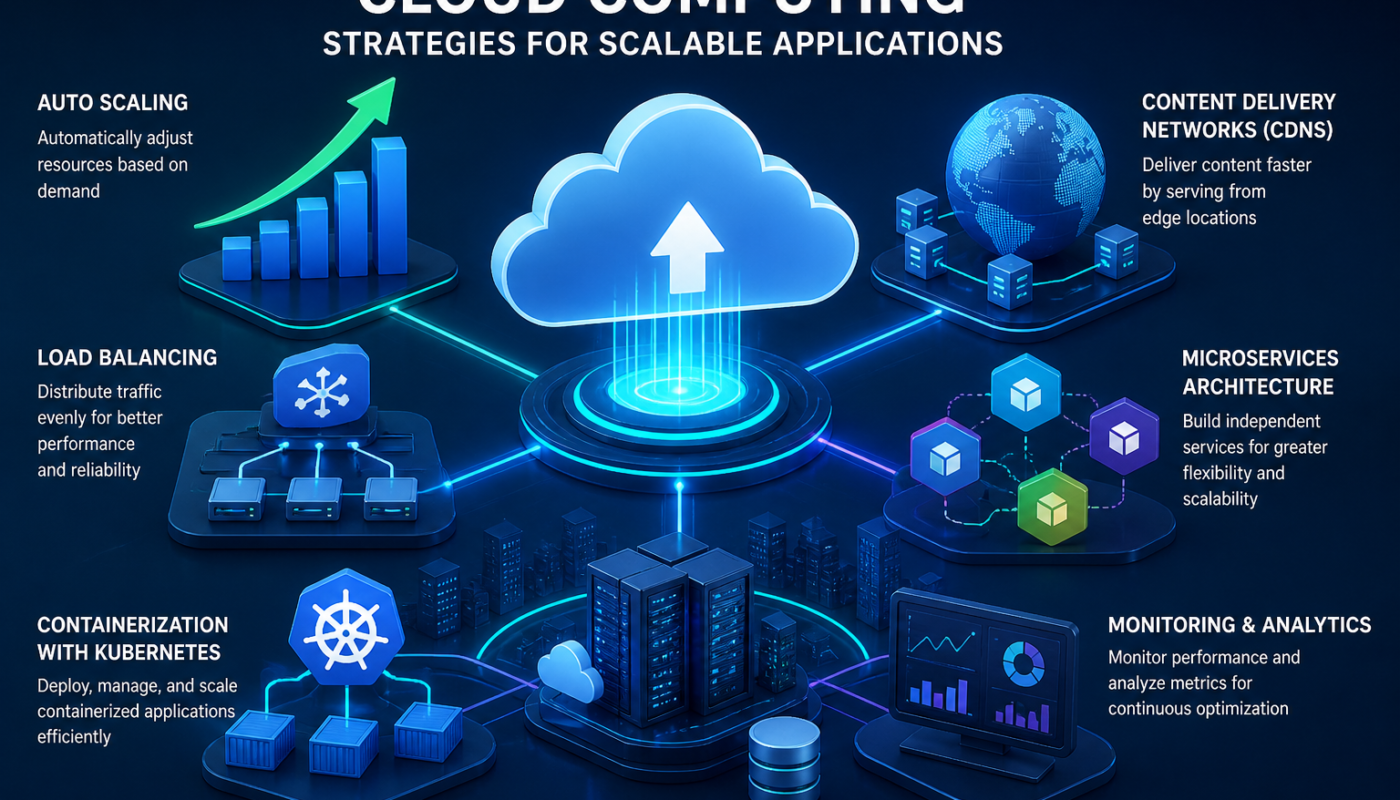
 by
Introduction
Cloud computing has transformed the way businesses build, deploy, and scale applications. From startups to global enterprises, cloud platforms provide flexibility, speed, and cost efficiency that traditional infrastructure cannot match. As digital transformation accelerates, scalable applications have become a necessity rather than an option.
Scalability means the ability of an application to handle increasing workloads without sacrificing performance. Whether it is managing traffic spikes, processing massive datasets, or serving users globally, cloud computing offers powerful strategies to ensure smooth operations.
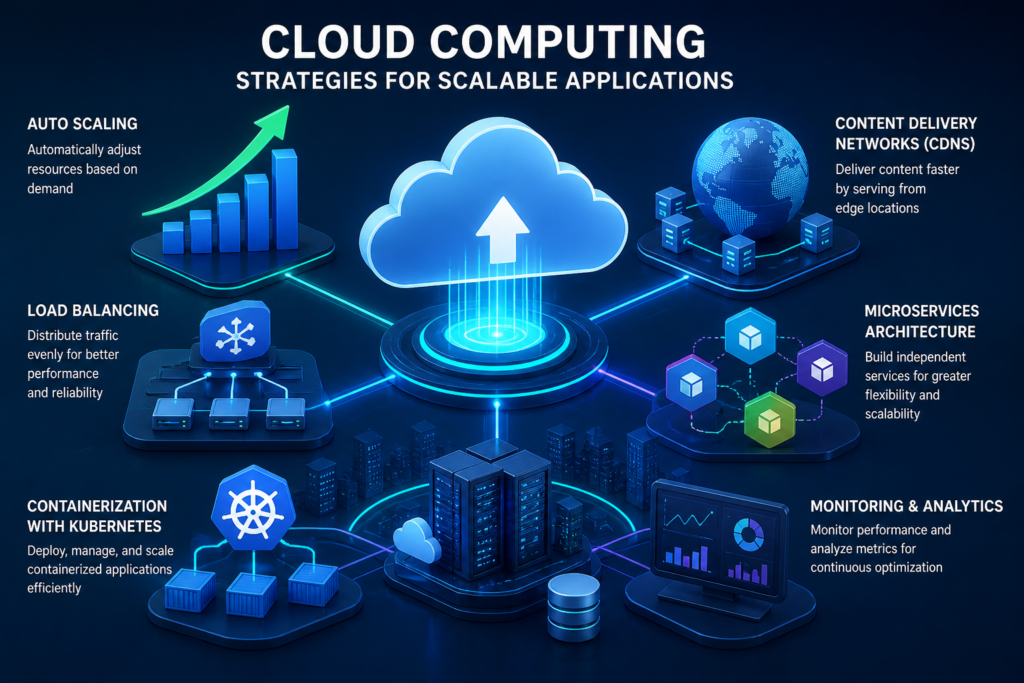
10 powerful cloud computing strategies
1. Adopt Auto Scaling for Dynamic Resource Allocation
Auto scaling is one of the most effective cloud computing strategies for dynamic resource management. Auto scaling is one of the most effective cloud strategies for scalability. It automatically adjusts computing resources based on workload demand.
Benefits of Auto Scaling:
- Handles traffic spikes efficiently
- Reduces downtime risks
- Optimizes cloud costs
- Improves application performance
For example, during peak shopping seasons, e-commerce applications can automatically increase server instances to manage heavy traffic.
Best Practices:
- Set CPU and memory thresholds
- Use predictive scaling
- Monitor application performance regularly
Auto scaling ensures your application grows and shrinks according to user demand.
2. Implement Load Balancing for Better Traffic Distribution
Load balancing distributes incoming traffic across multiple servers to prevent overload. Load balancing is among the top cloud computing strategies for application performance optimization.
Why It Matters:
Without load balancing, one server may become overwhelmed, causing slower response times or failures.
Advantages:
- High availability
- Improved fault tolerance
- Better user experience
- Enhanced application reliability
Cloud providers offer managed load balancing services that simplify traffic management.
Key Tip:
Use application load balancers for intelligent routing based on user behavior.
3. Use Microservices Architecture for Flexible Scaling
Microservices architecture is one of the most powerful cloud computing strategies for flexible scaling. Microservices break applications into smaller independent services. Modern microservices deployments depend on strong software supply chain security strategies to reduce third-party dependency risks and improve application security.
Why Microservices Help Scalability:
Instead of scaling the entire application, businesses can scale only the services experiencing high demand.
Benefits:
- Faster deployments
- Better fault isolation
- Easier maintenance
- Independent scalability
For example, in an online platform, payment services can scale separately from user authentication services.
4. Leverage Content Delivery Networks (CDNs)
A CDN distributes content across global servers to reduce latency. CDN implementation supports modern cloud computing strategies by improving content delivery speed.
How CDNs Improve Scalability:
By serving cached content from the nearest location, server load decreases significantly.
Benefits:
- Faster content delivery
- Reduced bandwidth costs
- Better global performance
- Improved security against attacks
CDNs are essential for websites with international users.
5. Optimize Database Performance with Cloud-Native Solutions
Database optimization remains essential in successful cloud computing strategies. Databases often become bottlenecks in scalable applications.
Cloud Database Optimization Strategies:
- Use managed databases
- Implement read replicas
- Enable database sharding
- Optimize indexing
Benefits:
- Faster query execution
- Better data availability
- Improved reliability
Cloud-native databases simplify management and improve scaling capabilities.
6. Implement Serverless Computing for Event-Driven Scalability
Serverless computing has become one of the most efficient cloud computing strategies for event-driven applications. Serverless architecture allows applications to run without managing servers.
Why Serverless Is Powerful:
Resources scale automatically based on the number of requests.
Advantages:
- No infrastructure management
- Pay only for usage
- Faster deployment
- Better scalability
Serverless functions are ideal for APIs, event processing, and automation tasks.
7. Enable Containerization with Kubernetes
Container orchestration strengthens cloud computing strategies by improving deployment consistency. Containers package applications with all dependencies for consistent deployment.
Why Containers Improve Scalability:
Containers allow applications to scale quickly across environments.
Kubernetes Benefits:
- Automated scaling
- Self-healing capabilities
- Efficient resource management
- Better deployment control
Container orchestration simplifies application scaling in cloud environments.
8. Use Multi-Cloud Strategy for High Availability
Multi-cloud adoption is one of the advanced cloud computing strategies for high availability.
A multi-cloud strategy uses multiple cloud providers for better resilience.
Benefits:
- Reduced vendor lock-in
- Better disaster recovery
- Improved reliability
- Enhanced performance optimization
Businesses can distribute workloads across providers for maximum availability.
Important Tip:
Plan workload distribution carefully to avoid complexity.
9. Strengthen Cloud Security for Scalable Growth
Security-focused cloud computing strategies are necessary for scalable cloud environments. Security is a critical factor in cloud scalability. Regular updates and enterprise patch management practices help strengthen cloud environments against vulnerabilities and security gaps.
Cloud Security Best Practices:
- Identity and access management (IAM)
- Encryption for data protection
- Zero trust implementation
- Security monitoring
Strong security ensures scalable applications remain protected from threats.
Security Impact:
A secure cloud environment reduces risks and improves business continuity.
10. Monitor and Optimize Cloud Performance Continuously
Performance monitoring supports effective cloud computing strategies by identifying system bottlenecks. Monitoring helps identify bottlenecks and improve application efficiency.
Key Monitoring Areas:
- CPU utilization
- Memory usage
- Response times
- Error rates
- Network performance
Benefits:
- Faster issue detection
- Better performance optimization
- Improved user experience
Use cloud monitoring tools to maintain optimal scalability.
Common Challenges in Cloud Scalability
Even with cloud strategies, businesses may face challenges:
1. Cost Management
Scaling resources can increase expenses if not monitored properly.
2. Security Risks
Misconfigured cloud resources can create vulnerabilities.
3. Data Management Complexity
Handling large datasets requires efficient storage strategies.
4. Performance Bottlenecks
Improper architecture can affect scaling efficiency.
Understanding these challenges helps businesses prepare better.
Best Practices for Building Scalable Cloud Applications
To maximize cloud scalability:
- Design for failure
- Use automation wherever possible
- Optimize APIs for performance
- Implement disaster recovery plans
- Use caching strategies
- Regularly test scalability under load
These practices improve application stability and performance.
Future of Cloud Computing Scalability
Cloud computing continues to evolve with advanced technologies such as:
- Artificial Intelligence optimization
- Edge computing integration
- Quantum computing support
- Autonomous cloud operations
Businesses adopting these innovations will gain better scalability and competitive advantages.
Conclusion
Cloud computing provides powerful opportunities for building scalable applications. By implementing strategies such as auto scaling, load balancing, microservices, serverless computing, and performance monitoring, businesses can create flexible, resilient, and high-performing applications.
Scalability is not just about handling growth—it is about delivering consistent user experiences, optimizing costs, and staying competitive in the digital era.
Organizations that adopt these cloud strategies today will be better prepared for future demands and technological changes.