 by
by Introduction
Software Supply Chain Security is a critical cybersecurity discipline that focuses on protecting applications from risks introduced through third-party dependencies, open-source libraries, APIs, cloud services, and development tools. In modern software engineering, almost every application is built using external components instead of being written entirely from scratch.
This dependency-driven development model has significantly improved speed, scalability, and cost efficiency. However, it has also introduced a major security challenge: attackers are now targeting the supply chain instead of directly attacking applications.
Instead of breaking into a system, cybercriminals inject malicious code into trusted libraries, compromise CI/CD pipelines, or exploit outdated dependencies. Once a compromised component enters the system, it can silently spread across the entire application ecosystem.
This shift has made software supply chain protection one of the most important areas in cybersecurity today. Organizations must ensure that every dependency, tool, and service used in development is verified, secure, and continuously monitored.
What is Software Supply Chain Security?
Software Supply Chain Security refers to the process of securing every stage of software development and deployment, including coding, building, testing, packaging, and releasing software.
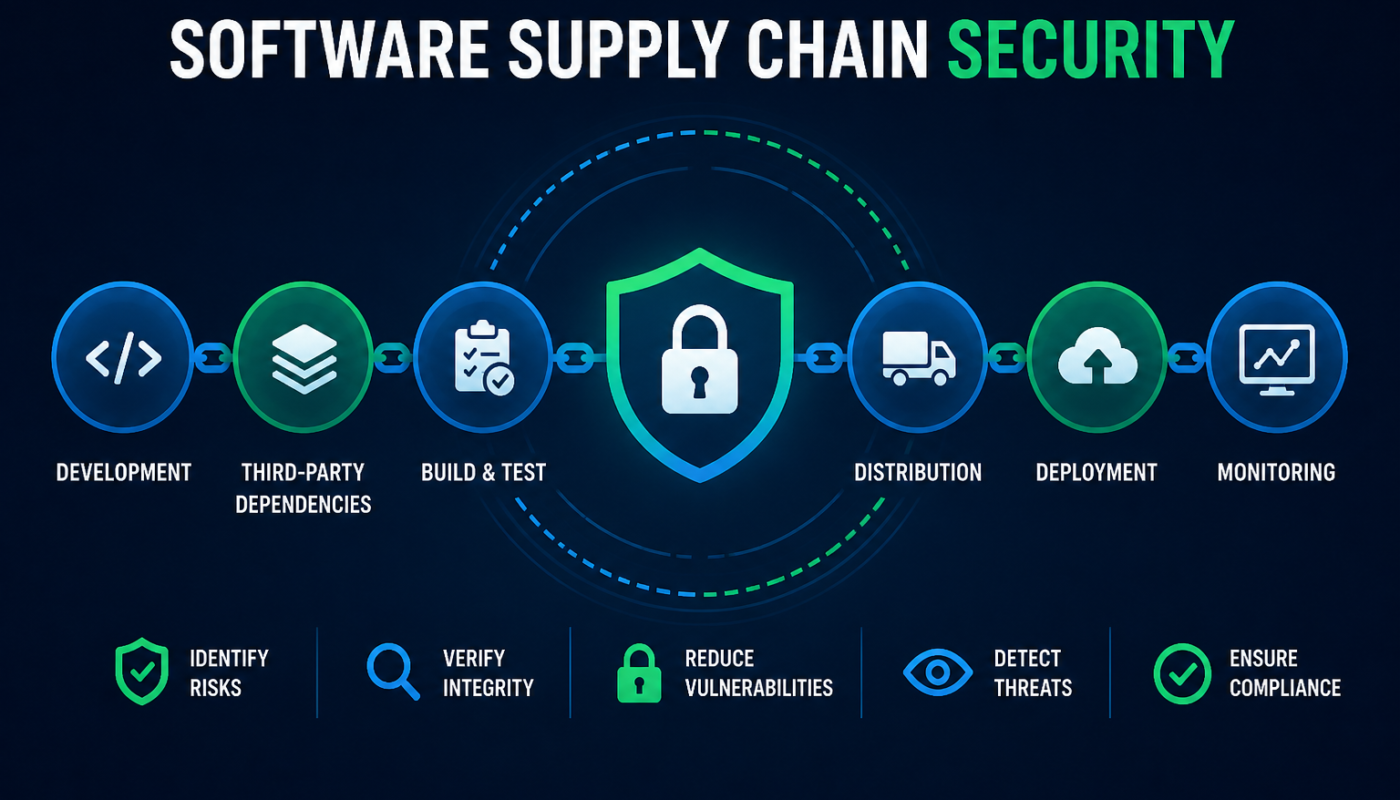
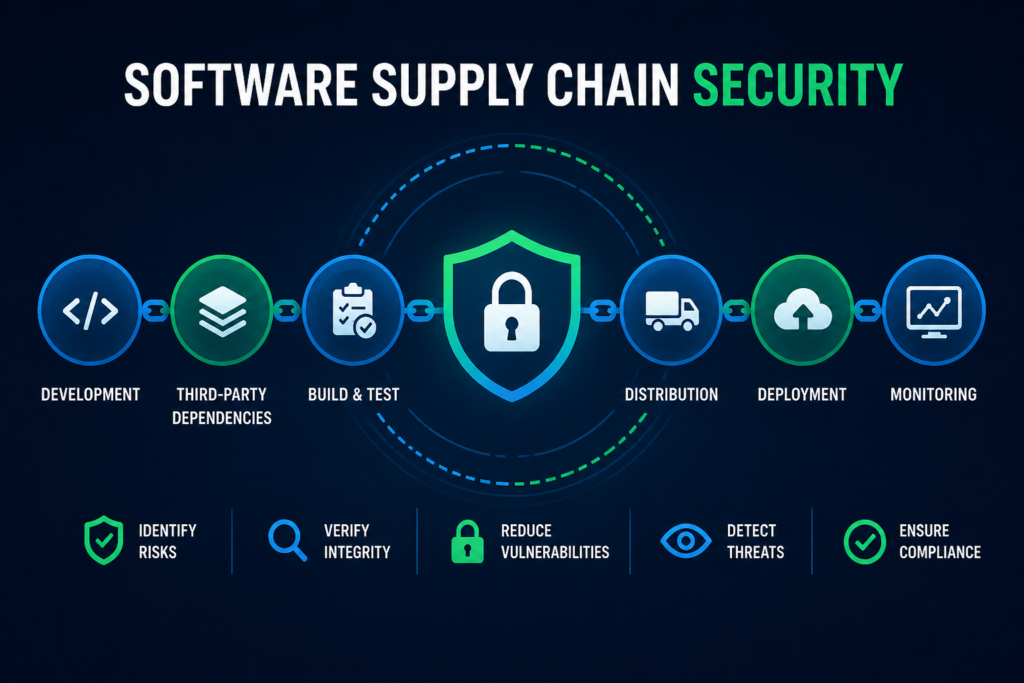
A modern software supply chain includes:
- Open-source libraries and frameworks
- Third-party APIs and SDKs
- Build tools and compilers
- CI/CD pipelines
- Container images and registries
- Cloud deployment systems
Each of these components introduces potential risk. If even one component is compromised, attackers can inject malicious code or gain unauthorized access to sensitive systems. Software Supply Chain Security ensures that all third-party dependencies used in applications are safe and verified.
For example, a compromised npm package or Python library can silently execute malicious scripts during installation, affecting thousands of applications that depend on it.
Secure API communication is also essential in this ecosystem, which connects with API Security in Cloud-Native Applications practices used to protect data flow between services.
How Software Supply Chain Attacks Work
Software supply chain attacks typically follow a pattern:
- Attackers target a popular open-source library or tool
- They inject malicious code into a trusted update
- Developers unknowingly install the compromised version
- Malicious code spreads across systems and environments
- Data theft, backdoors, or system compromise occurs
These attacks are dangerous because they exploit trust in legitimate software components.
Real-world examples include:
- Malicious npm packages stealing developer credentials
- Compromised build pipelines injecting ransomware
- Backdoored updates in widely used open-source libraries
9 Core Strategies to Protect Software Supply Chain
1. Maintain Software Bill of Materials (SBOM)
SBOM provides a complete inventory of all software components used in an application. It includes direct and indirect dependencies, versions, and sources.
With SBOM, organizations gain visibility into their entire software ecosystem, making it easier to detect vulnerable components quickly during security incidents.
2. Enforce Strict Dependency Version Control
Controlling dependency versions prevents unexpected or malicious updates from entering production systems. Locking versions ensures that only tested and verified components are used.
This reduces the risk of attackers exploiting newly released compromised versions of popular libraries.
3. Verify Package Integrity Before Installation
Every dependency must be validated using cryptographic hashes and digital signatures.
This ensures that the package has not been modified or tampered with during distribution, protecting against supply-side attacks.
4. Continuous Vulnerability Scanning
Continuous scanning tools check dependencies against global vulnerability databases (CVEs).
This helps identify:
- Outdated libraries
- Known security flaws
- Risky transitive dependencies
Early detection ensures faster mitigation and reduces attack exposure.
5. Secure CI/CD Pipeline Infrastructure
CI/CD pipelines are a major attack target because they control how software is built and deployed.
Strong Software Supply Chain Security is required for secure CI/CD pipelines.
Security measures include:
- Role-based access control (RBAC)
- Secret management systems
- Isolated build environments
- Signed build artifacts
A compromised pipeline can directly inject malicious code into production systems.
6. Use Only Trusted and Maintained Dependencies
Not all open-source packages are safe. Some are abandoned or poorly maintained, making them vulnerable to exploitation. Software Supply Chain Security ensures only verified dependencies are used.
Before using any dependency, organizations must evaluate:
- Maintenance activity
- Community trust
- Security update frequency
- Contributor reputation
7. Runtime Application Self-Protection (RASP)
RASP provides real-time protection by monitoring application behavior during execution.
It can:
- Detect abnormal behavior
- Block malicious requests
- Prevent code injection attacks
Even if a dependency is compromised, RASP can reduce damage in real time.
8. Zero Trust Security Model
Zero Trust means no component is automatically trusted.
Every dependency, API call, and service interaction must be verified before access is granted.
This eliminates implicit trust and prevents attackers from moving laterally within systems.
9. Continuous Monitoring and Governance
Continuous Software Supply Chain Security monitoring helps detect threats early.
Security must be continuous, not a one-time setup.
Organizations must:
- Monitor dependency updates
- Track security advisories
- Remove unused libraries
- Enforce security policies
This ensures long-term protection against evolving threats.
Real-World Impact of Supply Chain Attacks
Software supply chain attacks can cause severe damage:
- Data breaches affecting millions of users
- Financial losses due to ransomware
- Service downtime in critical systems
- Reputation damage for organizations
One compromised dependency can impact thousands of downstream applications, making this one of the most dangerous attack vectors today.
Benefits of Software Supply Chain Security
Implementing strong supply chain security provides multiple advantages:
- Reduces cyber attack surface
- Improves system reliability
- Strengthens application integrity
- Enhances regulatory compliance
- Builds trust in software systems
Challenges in Implementation
Managing large systems without Software Supply Chain Security increases vulnerability risk.
Despite its importance, organizations face several challenges:
- Managing large dependency trees
- Detecting hidden transitive vulnerabilities
- Securing complex CI/CD pipelines
- Keeping up with fast-evolving threats
- Maintaining accurate SBOM records
Future of Software Supply Chain Security
The future of supply chain security will be highly automated and AI-driven.
We will see:
- AI-based vulnerability detection systems
- Automated SBOM generation
- Real-time dependency monitoring
- Predictive security analysis
- Self-healing CI/CD pipelines
Security will move from reactive defense to proactive and predictive protection.
Conclusion
Software Supply Chain Security has become one of the most critical aspects of modern cybersecurity. As applications increasingly rely on third-party components, the risk of dependency-based attacks continues to grow.
Organizations must adopt a layered security approach that includes visibility, verification, monitoring, and runtime protection.
By implementing SBOM, dependency control, integrity verification, CI/CD security, and Zero Trust principles, businesses can significantly reduce risk and build resilient software systems.
In today’s digital world, securing software means securing everything your software depends on.



One thought on “9 Powerful Software Supply Chain Security Strategies to Prevent Third-Party Dependency Attacks”