
 by
by Introduction
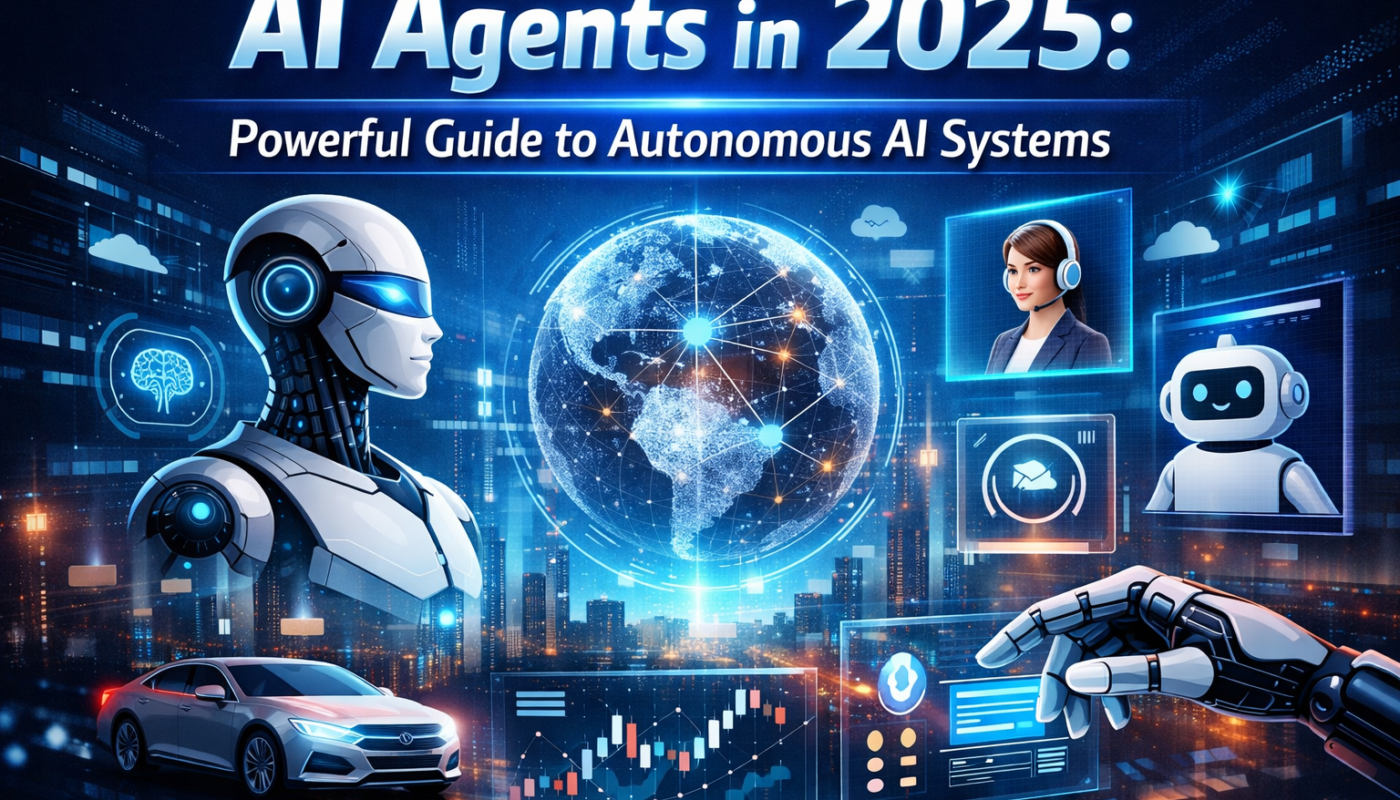
AI Agents in 2025 are changing the way digital systems operate. These autonomous AI systems can perform tasks, make decisions, and improve themselves without constant human input. Businesses, developers, and organizations are using AI agents to automate complex workflows and increase efficiency. This guide explains everything you need to know about AI agents in a clear and structured way.AI Agents in 2025 are becoming essential for businesses looking to automate processes and improve efficiency.
What Are AI Agents
AI agents are intelligent software systems that can observe their environment, process information, and take actions to achieve specific goals. According to IBM, AI agents are transforming modern automation systems.AI Agents in 2025 are more advanced compared to earlier systems and can handle complex decision making.
Key characteristics of AI agents
- They can make decisions independently
- They learn from data and experience
- They can interact with users or systems
- They perform tasks automatically
Examples include chatbots, virtual assistants, and automated business tools.
How AI Agents Work
AI agents follow a structured process to complete tasks.
Step 1 Input
The agent receives data or a user request
Step 2 Processing
It analyzes the input using machine learning and algorithms.It is similar to applications built using MERN Stack and often runs on platforms like Google Cloud.
Step 3 Decision Making
The agent decides the best possible action
Step 4 Execution
It performs the required task
Step 5 Learning
The system improves based on feedback and results
Watch AI Agents Explained for Beginners
Types of AI Agents
There are different types of AI Agents in 2025 based on functionality and intelligence level.
- Simple Reflex Agents
These agents respond directly to specific inputs without storing past data - Model-Based Agents
They maintain internal data to make better decisions - Goal-Based Agents
They act to achieve specific objectives - Utility-Based Agents
They evaluate multiple outcomes and choose the best one - Learning Agents
They continuously improve using data and experience
Real World Applications of AI Agents
These examples show how AI Agents in 2025 are used across industries.
- Customer Support
Automated chat systems handle queries efficiently - E-commerce
AI agents recommend products and manage orders - Healthcare
Assist in diagnosis and patient monitoring - Finance
Detect fraud and automate trading - Digital Marketing
Optimize campaigns and analyze user behavior
Advantages of AI Agents
- Increased productivity
- Reduced human effort
- Faster decision making
- Continuous operation without breaks
- Improved accuracy and efficiency
Limitations of AI Agents
- Data privacy concerns
- High implementation cost
- Dependence on quality data
- Security risks
- Lack of human judgment in complex situations
Future of AI Agents in 2025 and Beyond
AI Agents in 2025 are not just tools for automation but are becoming intelligent digital systems capable of handling complex decision making and multi-step tasks. As technology continues to evolve, AI agents will play a critical role in transforming industries, business operations, and daily life.
1. Rise of Fully Autonomous Systems
In the coming years, AI agents will move beyond simple automation and become fully autonomous systems. These agents will be capable of planning, executing, and optimizing tasks without human intervention. Businesses will increasingly rely on AI agents to manage operations such as customer service, logistics, and data processing.
2. Integration with Multiple Technologies
AI agents will not work in isolation. They will integrate deeply with other technologies such as cloud computing, Internet of Things, and big data systems. This integration will allow AI agents to access real-time data, monitor devices, and make faster and more accurate decisions across connected systems.
3. Growth of Multi-Agent Systems
Instead of a single AI agent performing tasks, organizations will deploy multiple AI agents working together. These multi-agent systems will collaborate, communicate, and divide tasks efficiently. For example, one agent may handle data collection, another analysis, and another execution, creating a complete automated workflow.
4. Personal AI Assistants Becoming More Advanced
AI agents will evolve into highly personalized assistants. They will understand user behavior, preferences, and habits. These assistants will manage schedules, automate daily tasks, provide recommendations, and even make decisions on behalf of users in areas such as shopping, finance, and productivity.
5. Expansion in Business and Enterprise Use
Enterprises will adopt AI agents at a large scale. They will be used for process automation, decision support, and predictive analytics. AI agents will help companies reduce costs, improve efficiency, and gain competitive advantages by analyzing large volumes of data quickly.
6. AI Agents in Software Development
AI agents will assist developers by writing code, testing applications, detecting bugs, and optimizing performance. This will significantly reduce development time and improve software quality. Development environments will increasingly include AI-powered assistants as a standard feature.
7. Improved Decision Making with Real-Time Data
Future AI agents will have the ability to process real-time data streams. This will allow them to make instant decisions in critical situations such as financial trading, healthcare monitoring, and cybersecurity threat detection.
8. Increased Focus on Security and Ethics
As AI agents become more powerful, concerns related to security, privacy, and ethical use will also grow. Organizations will implement stricter regulations and frameworks to ensure that AI agents operate safely and responsibly. Cybersecurity measures will be essential to protect AI systems from attacks.
9. No-Code and Low-Code AI Development
The development of AI agents will become more accessible through no-code and low-code platforms. This will allow non-technical users to create and deploy AI agents for various tasks, increasing adoption across different industries.
10. Future Job Transformation
AI agents will not only automate tasks but also change the nature of jobs. While some repetitive roles may be reduced, new opportunities will emerge in AI management, system design, data analysis, and automation strategy. Professionals will need to adapt and upgrade their skills to work alongside AI agents.
Overall, AI Agents in 2025 will continue to evolve and dominate the IT industry.
Advanced Features of AI Agents
AI agents in 2025 come with advanced capabilities that make them more powerful and efficient.
- Context awareness
AI agents understand user context and environment before taking actions - Memory and learning ability
They store past interactions and improve over time - Multi-tasking capability
AI agents can perform multiple tasks simultaneously - Natural language understanding
They can understand and respond in human language
AI Agents vs Traditional Software
AI agents are different from traditional software systems.
- Traditional software follows fixed rules
- AI agents learn and adapt dynamically
- Traditional systems require manual updates
- AI agents improve automatically with data
Key Technologies Behind AI Agents
AI agents are powered by multiple technologies.
- Machine Learning
- Natural Language Processing
- Deep Learning
- Computer Vision
- Big Data Analytics
Architecture of AI Agents
The structure of AI agents includes multiple components.
- Perception module
Collects data from environment - Decision module
Processes information and selects actions - Action module
Executes tasks - Learning module
Improves performance over time
AI Agents in Different Industries
AI agents are used across various sectors.
- Healthcare for diagnosis and monitoring
- Finance for fraud detection and trading
- Education for personalized learning
- Retail for customer experience
- Logistics for supply chain optimization
Challenges in Implementing AI Agents
Organizations face several challenges.
- Data availability and quality
- High development and maintenance cost
- Integration with existing systems
- Ethical and legal concerns
- Skill gap in AI technologies
Security Risks in AI Agents
Security is a major concern.
- Data breaches
- Unauthorized access
- AI manipulation attacks
- System vulnerabilities
Best Practices for Using AI Agents
To use AI agents effectively.
- Use high-quality data
- Regularly monitor performance
- Ensure data security
- Update models continuously
- Combine human and AI decision making
Skills Required to Work with AI Agents
Professionals need specific skills.
- Programming knowledge
- Understanding of AI and machine learning
- Data analysis skills
- Problem solving ability
- Knowledge of automation tools
Conclusion
AI Agents in 2025 are transforming the landscape of Information Technology by enabling intelligent automation and autonomous decision making. These systems are no longer limited to basic tasks but are capable of handling complex workflows across industries such as healthcare, finance, and digital marketing.
As organizations continue to adopt AI-driven solutions, the demand for AI agents will increase significantly. Businesses that leverage this technology can improve efficiency, reduce operational costs, and gain a competitive advantage in the market.
However, along with benefits, it is important to address challenges such as data privacy, security, and ethical concerns. Proper implementation and monitoring are essential to ensure safe and effective use of AI agents.
In the future, AI agents will become more advanced, integrated, and accessible, playing a key role in shaping the next generation of digital systems. For individuals and professionals, learning and adapting to this technology will be crucial to stay relevant in the evolving IT industry.


2 thoughts on “AI Agents in 2025: Powerful Guide to Autonomous AI Systems”