
 by
by Introduction
Modern backend systems are no longer simple request-response applications. Today’s digital platforms handle millions of users, real-time updates, payments, notifications, analytics, and microservices communication simultaneously.
In such environments, direct API calls between services create bottlenecks and system failures under heavy load. That’s why Backend Queue Management in 2025 has become a core foundation of scalable system design.
Message queues allow systems to communicate asynchronously, process workloads efficiently, and stay stable even during extreme traffic spikes.
Why Backend Queue Management is Important
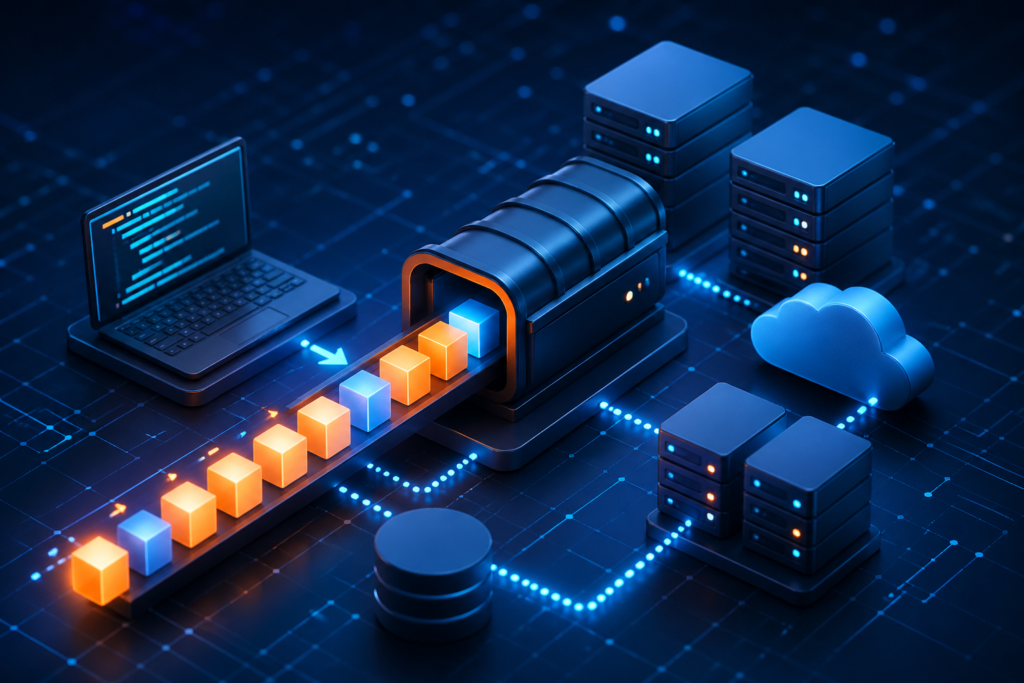
In Backend Queue Management in 2025, message queues act as a buffer layer that improves system stability under heavy traffic. Backend queue systems act as a buffer layer between services and workloads, ensuring smooth execution even when demand is unpredictable.
Key Benefits:
- Prevent system overload during traffic spikes
- Enable asynchronous processing
- Improve system responsiveness
- Support microservices communication
- Increase fault tolerance and reliability
Without queue systems, modern cloud applications cannot scale efficiently.
What is a Message Queue?
A message queue is a communication system where data (messages) is sent by a producer and stored temporarily until a consumer processes it.
Instead of direct communication:
Service A → Service B (synchronous)
We use:
Service A → Queue → Service B (asynchronous)
This decouples systems and improves scalability.
8 Powerful Message Queue Strategies for Scalable Backend Systems
Now let’s explore the most important strategies used in modern backend architectures in 2025.
1. Event-Driven Architecture with Message Queues
Event-driven architecture is the backbone of modern distributed systems. This approach is widely used in modern microservices-based systems where services communicate through events instead of direct calls.
How it works:
- A service generates an event (e.g., “Order Placed”)
- Message queue stores the event
- Multiple services consume and react independently
Benefits:
- Loose coupling between services
- High scalability
- Easy system expansion
This approach is widely used in modern cloud-native applications.
2. Asynchronous Task Processing
Instead of blocking APIs with heavy tasks, backend systems push them into queues. This improves system speed and is a key part of backend performance optimization in modern systems. This is a key concept in Backend Queue Management in 2025, especially for handling background jobs efficiently.
Examples:
- Email sending
- Payment processing
- Image/video processing
- Data analytics jobs
Benefits:
- Faster API response time
- Reduced server load
- Better user experience
3. Queue Partitioning for Load Distribution
Queue partitioning divides workloads into multiple segments for better performance.
How it works:
- Split queues by region, topic, or priority
- Assign different consumers to each partition
- Balance workload dynamically
Benefits:
- Prevents bottlenecks
- Improves throughput
- Ensures fair resource usage
4. Dead Letter Queue (DLQ) Handling
Not all messages are processed successfully.
Process:
- Failed messages move to a separate DLQ
- Stored for debugging or reprocessing
- Prevents system blockage
Benefits:
- No message loss
- Easier debugging
- Better system reliability
5. Priority-Based Message Queuing
Not all tasks are equally important.
Priority levels:
- High: Payments, authentication
- Medium: Notifications
- Low: Logging, analytics
Benefits:
- Critical tasks processed first
- Improved SLA performance
- Better control over system behavior
6. Horizontal Scaling with Distributed Queues
Modern systems scale horizontally instead of vertically.
How it works:
- Multiple queue brokers across servers
- Multiple consumers process messages in parallel
- Load distributed automatically
Benefits:
- High scalability
- Fault tolerance
- Better performance under load
7. Queue Monitoring and Observability
Monitoring ensures system health and performance stability.
Key metrics:
- Queue length
- Processing latency
- Failure rate
- Consumer throughput
Benefits:
- Early issue detection
- Performance optimization
- System stability
8. Hybrid Queue Architecture (Cloud + On-Premise)
Enterprises often use hybrid systems for flexibility and compliance.
Why hybrid systems:
- Data security requirements
- Regulatory compliance
- Multi-cloud architecture
Benefits:
- Better control
- High flexibility
- Cost optimization
Real-World Example: E-Commerce System
Let’s understand how queue systems work in real life.
Without queues:
- API crashes during flash sales
- Payment failures
- Poor user experience
With queues:
- Orders stored in queue
- Payments processed asynchronously
- Inventory updated in real-time
- Notifications handled separately
Result: stable system even under heavy traffic
Message Queue Technologies
Modern systems use different tools based on requirements:
- Kafka-style streaming systems
- RabbitMQ message brokers
- Cloud-native queue services
- Redis-based streaming systems
Each has its own strengths depending on scalability, latency, and architecture needs.
Challenges in Backend Queue Management
Even advanced systems face challenges:
- Message duplication
- Queue congestion
- Latency spikes
- Ordering issues
- Debugging complexity
Proper architecture design helps reduce these problems significantly.
Future of Backend Queue Management
In 2025 and beyond, queue systems are evolving rapidly.
Future Trends:
- AI-based queue optimization
- Auto-scaling consumers
- Serverless queue systems
- Predictive load balancing
- Real-time event streaming
Systems are becoming more intelligent and self-managing.
Conclusion
Backend Queue Management in 2025 is a critical foundation for scalable and high-performance systems. It enables asynchronous processing, system decoupling, and efficient handling of large-scale traffic.
Backend Queue Management in 2025 helps developers build scalable, reliable, and high-performance backend systems.
By implementing strategies like event-driven architecture, priority queues, and distributed systems, developers can build robust backend systems capable of handling real-world production demands.