
 by
by Introduction
Microservices Architecture in 2025 is one of the most important software design approaches used to build scalable, flexible, and cloud-native applications in modern development. In 2025, software systems are no longer simple standalone applications. Businesses operate globally, handle millions of users, process real-time data, and require continuous updates without downtime. Traditional monolithic architecture, where an entire application is built as a single unit, struggles to meet these demands.
To solve this, modern software engineering has widely adopted Microservices Architecture, a design approach where applications are broken into multiple small, independent services that work together as a unified system.
Each service focuses on a single business capability such as authentication, payments, user management, or notifications. These services can be developed, deployed, and scaled independently, making the system more flexible, resilient, and scalable.
What is Microservices Architecture?
In Microservices Architecture in 2025, applications are designed as a collection of independent services. Microservices Architecture is a software design pattern where an application is structured as a collection of loosely coupled services.
Each microservice:
- Handles one specific function
- Runs independently
- Has its own deployment lifecycle
- Communicates through APIs or messaging systems
Simple Example:
Instead of building one large system for an e-commerce platform, it is divided into:
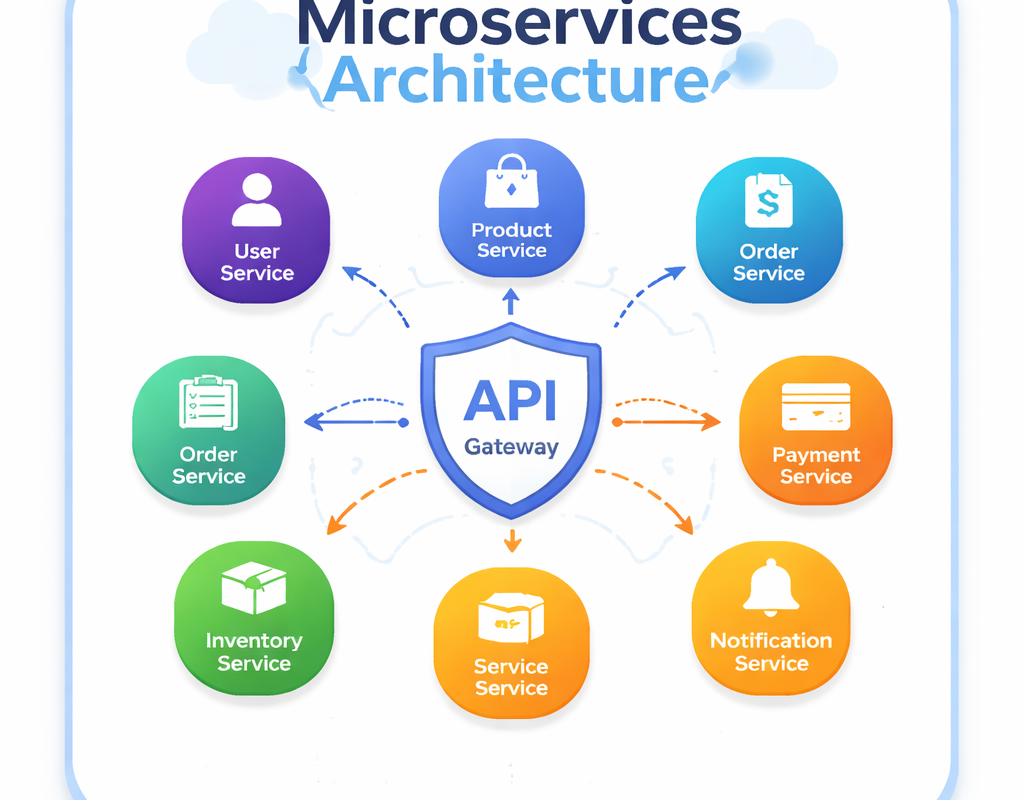
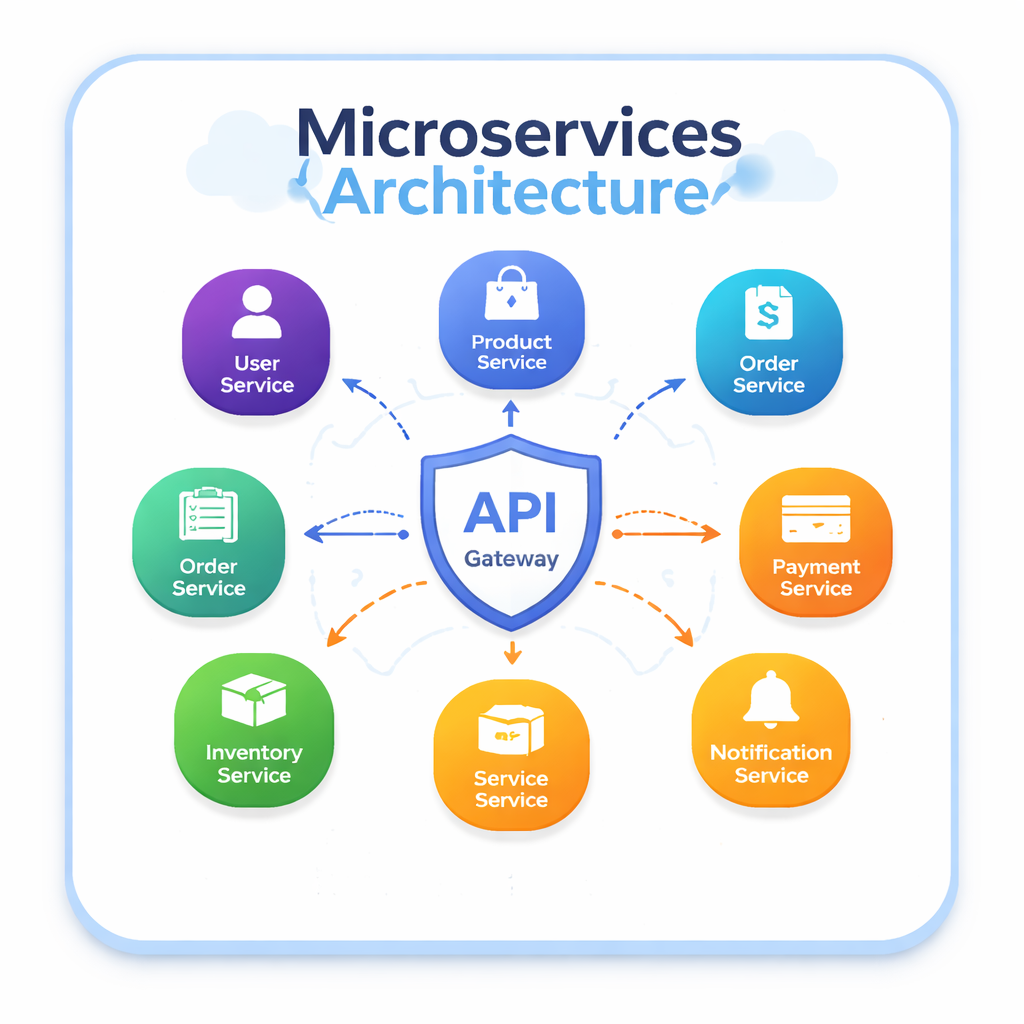
- User Service (login/signup)
- Product Service (catalog management)
- Order Service (order processing)
- Payment Service (transactions)
- Notification Service (email/SMS alerts)
Each module works independently but contributes to a complete system.
How Microservices Architecture Works
Microservices communicate through lightweight protocols, usually over a network.
Communication Methods:
- REST APIs (most common)
- GraphQL APIs (efficient data fetching)
- Message Brokers (Kafka, RabbitMQ for asynchronous communication)
Workflow:
- A user sends a request (e.g., placing an order)
- API Gateway receives the request
- Request is routed to relevant microservices
- Each service performs its task independently
- Results are combined and sent back to the user
This distributed nature ensures that each part of the system works efficiently without affecting others.
Key Features of Microservices
1. Independent Deployment
Each microservice can be deployed separately without affecting the entire application. This reduces downtime and improves development speed.
2. Scalability
Services can be scaled individually based on demand. For example, during high traffic, only the payment service can be scaled instead of the whole system.
3. Fault Isolation
If one service fails, it does not crash the entire system. Other services continue working normally.
4. Technology Flexibility
Different services can use different technologies:
- Node.js for APIs
- Python for AI/ML services
- Java for enterprise logic
- Go for high-performance services
Microservices in Cloud & DevOps
Modern systems using Microservices Architecture in 2025 rely heavily on cloud-native infrastructure. Microservices are deeply connected with cloud-native architecture and DevOps practices.
Cloud Integration:
Microservices are usually deployed using cloud platforms where:
- Docker containers package services
- Kubernetes manages orchestration
- Auto-scaling handles traffic spikes
- Load balancers distribute requests
This makes systems highly available and resilient.
DevOps Integration:
DevOps plays a critical role in microservices by enabling:
- CI/CD pipelines for automated deployment
- Continuous testing for each service
- Monitoring and logging systems
- Fast rollback in case of failure
Without DevOps, managing microservices becomes extremely complex.
Security in Microservices Architecture
Security in Microservices Architecture in 2025 requires strong authentication and API protection.
While microservices improve flexibility, they also increase the number of entry points, which creates security challenges.
Key Security Practices:
- API Gateway security enforcement
- JWT and OAuth2 authentication
- Role-based access control (RBAC)
- Encrypted communication using HTTPS/TLS
- Centralized logging and monitoring
Security Challenges:
- More APIs mean more attack surfaces
- Inter-service communication risks
- Complex identity management across services
This is why strong cybersecurity practices are essential in microservices-based systems.
Real-World Use Case Example
E-Commerce System:
A modern e-commerce platform uses microservices like:
- User Service → handles login, registration
- Product Service → manages product listings
- Cart Service → manages shopping cart
- Order Service → processes orders
- Payment Service → handles transactions securely
- Notification Service → sends updates via email/SMS
Each service can be developed by different teams and deployed independently, allowing faster innovation and scaling.
Advantages of Microservices Architecture
Microservices offer several key benefits:
- High scalability for enterprise systems
- Faster development cycles
- Independent service deployment
- Better fault tolerance
- Easier long-term maintenance
- Improved system flexibility
These advantages make microservices ideal for cloud-native applications and modern enterprise systems.
Challenges of Microservices
Despite its benefits, microservices also introduce complexity:
1. System Complexity
Managing multiple services is more complex than a single application.
2. Debugging Difficulty
Tracing errors across multiple services can be challenging.
3. Network Latency
Inter-service communication adds latency.
4. Infrastructure Cost
More services require more infrastructure resources.
5. DevOps Dependency
Strong CI/CD and monitoring systems are required for smooth operation.
Tools and Technologies Used
Backend Development:
- Node.js
- Spring Boot
- Python (FastAPI, Flask)
Containerization:
- Docker
Orchestration:
- Kubernetes
Messaging Systems:
- Apache Kafka
- RabbitMQ
Monitoring & Logging:
- Prometheus
- Grafana
- ELK Stack
These tools help manage distributed systems efficiently.
Future of Microservices in 2025 and Beyond
Microservices are evolving rapidly with advanced technologies:
- AI-driven service orchestration
- Serverless microservices architecture
- Edge computing integration
- Self-healing distributed systems
- Predictive auto-scaling based on traffic patterns
In the future, microservices will become even more automated, reducing human intervention in system management.
YouTube Learning Resource
For visual understanding and deeper learning:
FAQs
Q1. What is Microservices Architecture in simple words?
It is a method of building applications by breaking them into small independent services that work together.
Q2. Why is microservices used in 2025?
Because it supports scalability, faster deployment, and cloud-native application development.
Q3. Is microservices better than monolithic architecture?
Yes, for large applications. It provides better flexibility and fault isolation.
Q4. What are the main challenges of microservices?
Complex design, debugging difficulty, and higher infrastructure management requirements.
Q5. Which companies use microservices?
Many large tech companies use it for scalable systems, such as e-commerce, streaming, and cloud platforms.
Conclusion
Microservices Architecture in 2025 is a powerful approach for building modern applications that are scalable, flexible, and highly resilient Microservices Architecture is a powerful approach for building modern applications in 2025. It enables organizations to create scalable, flexible, and resilient systems that can handle complex workloads efficiently.
However, it also requires strong DevOps practices, security management, and cloud infrastructure to be implemented successfully.



4 thoughts on “Microservices Architecture in 2025: Powerful Strategies for Building Scalable Modern Applications”