

 by
by Introduction
Modern web scalability in 2025 is essential for building high-performance applications that can handle millions of users efficiently. Web applications today must handle millions of users simultaneously, real-time interactions, and unpredictable traffic spikes.
From platforms like eCommerce websites to SaaS applications, scalability has become the backbone of success. A single performance failure can result in user drop-offs, revenue loss, and brand damage.
Modern users expect:
- Instant loading speed
- Global accessibility
- Seamless experience during peak traffic
This is where modern web scalability plays a crucial role.
In this comprehensive guide, we will explore 7 proven techniques that help businesses build scalable, reliable, and high-performance web systems in 2025.

Understanding Web Scalability in Depth
Web scalability is the ability of a system to handle increasing workload without affecting performance, speed, or reliability.
Types of Scaling
1. Vertical Scaling (Scaling Up)
- Increasing CPU, RAM, and storage
- Simple but limited
- Expensive in long-term
2. Horizontal Scaling (Scaling Out)
- Adding multiple servers
- Distributing traffic
- Highly flexible and reliable
In 2025, companies prefer horizontal scaling with distributed systems.
7 Proven Web Scalability Techniques in 2025
1. Load Balancing for High Traffic Management
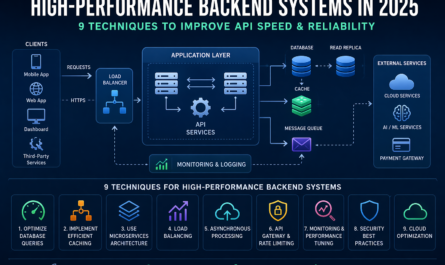
Load balancing is the first step toward scalability. It distributes incoming traffic across multiple servers, ensuring no single server gets overloaded. Load balancing is a key part of modern web scalability in 2025 for distributing traffic across multiple servers.
Why It’s Important:
- Prevents crashes during high traffic
- Improves application uptime
- Enhances performance
Real-World Example:
When a website receives 1 million requests, a load balancer ensures:
- Server A handles 300k
- Server B handles 300k
- Server C handles 400k
Popular Tools:
- NGINX
- HAProxy
- AWS Elastic Load Balancer
Without load balancing, even powerful systems can fail instantly.
2. Microservices Architecture for Flexibility
Traditional monolithic systems are hard to scale because everything is interconnected.Microservices architecture solves this by breaking the system into independent services. Microservices architecture improves modern web scalability in 2025 by allowing independent scaling of services.
Example:
- Authentication Service
- Payment Service
- User Management Service
Each can scale independently.
Benefits:
- Faster updates
- Better fault isolation
- Independent scaling
This is widely used by companies like Netflix and Amazon.
3. Advanced Caching Strategies
Caching is one of the most powerful techniques for improving performance. Caching improves performance in modern web scalability in 2025 systems by reducing database load.
Instead of fetching data repeatedly from the database, caching stores frequently accessed data in memory.
Types of Caching:
- Browser caching
- Server-side caching
- CDN caching
Tools:
- Redis
- Memcached
Impact:
- Reduces server load
- Improves response time
- Handles high traffic efficiently
Proper caching can reduce database queries by 70–90%.
4. Content Delivery Network (CDN)
A CDN distributes your content across multiple global servers. CDN is essential in modern web scalability in 2025 to deliver content faster globally.
How It Works:
When a user visits your website:
- Content is served from the nearest server
- Reducing latency
Benefits:
- Faster loading speed
- Improved user experience
- Reduced backend load
Essential for global applications.
5. Database Optimization & Scaling
Database performance is a major bottleneck in scalability. Database optimization is critical in modern web scalability in 2025 to handle large datasets efficiently.
Key Techniques:
Indexing
Speeds up data retrieval
Query Optimization
Reduces execution time
Sharding
Splits database into smaller parts
Read Replicas
Handles read-heavy workloads
Pro Tip:
Use a hybrid approach:
- SQL → Structured data
- NoSQL → High-speed operations
Smart database design = better scalability.
6. Cloud Auto Scaling
Cloud computing has revolutionized scalability.
Auto-scaling automatically adjusts resources based on traffic.
Platforms:
- AWS
- Google Cloud
- Azure
Example:
- Traffic spike → More servers added
- Traffic drop → Servers reduced
Benefits:
- Cost efficiency
- Zero downtime
- Fully automated
This is a must-have feature in 2025.
7. Monitoring & Observability
Without monitoring, scaling becomes guesswork.
Observability tools help track system performance in real-time.
Key Metrics:
- Response time
- CPU usage
- Error rates
- Request throughput
Tools:
- Prometheus
- Grafana
- Datadog
Early detection = faster resolution.
Common Scalability Mistakes
Many businesses fail due to poor planning.
1. Ignoring Load Testing
Always test your system under heavy load.
2. Poor Database Design
Leads to slow queries and crashes.
3. No Caching Strategy
Increases server load unnecessarily.
4. Single Server Dependency
Creates a single point of failure.
5. Lack of Monitoring
Issues go unnoticed until it’s too late.
Future Trends in Web Scalability
AI-Based Scaling
Systems automatically adjust using AI predictions.
Serverless Architecture
No need to manage servers.
Edge Computing
Processing happens closer to users.
Event-Driven Systems
Real-time communication between services.
These trends will dominate the future of web applications.
FAQs
1. What is web scalability in simple terms?
It is the ability of a system to handle increasing users without slowing down.
2. Which scaling method is best in 2025?
Horizontal scaling with cloud infrastructure is the best approach.
3. How does caching improve scalability?
It reduces database load and improves speed significantly.
4. Why is CDN important?
It delivers content faster by reducing distance between server and user.
5. What tools help in scalability?
Load balancers, cloud platforms, caching tools, and monitoring systems.
Conclusion
Modern web scalability is the foundation of successful digital platforms. In 2025, businesses must adopt advanced strategies like load balancing, microservices, caching, and cloud auto-scaling to handle massive user traffic. Adopting modern web scalability in 2025 strategies helps achieve long-term success.
By implementing these techniques, you can ensure:
- High performance
- Zero downtime
- Seamless user experience
Scalability is not just about growth—it’s about sustaining performance at scale.



5 thoughts on “Modern Web Scalability in 2025: 7 Proven Techniques to Handle Millions of Users Efficiently”