
 by
by Introduction
High-performance backend systems in 2025 are the backbone of modern digital applications. Every mobile app, SaaS platform, fintech system, and AI-driven service depends on fast and reliable backend APIs.
Today’s users expect instant responses. Even a delay of a few milliseconds can reduce engagement and increase bounce rates. That is why building High-Performance Backend Systems in 2025 is no longer optional—it is a core engineering requirement.
Modern systems must handle millions of requests, real-time processing, and global traffic while maintaining speed, uptime, and security.
Why High-Performance Backend Systems in 2025 Matter
The importance of High-Performance Backend Systems in 2025 is increasing due to:
- Rapid growth of cloud applications
- Microservices-based architecture adoption
- Real-time data processing needs
- High API dependency across apps
- User demand for instant performance
Without backend optimization, even the best frontend cannot deliver good performance.
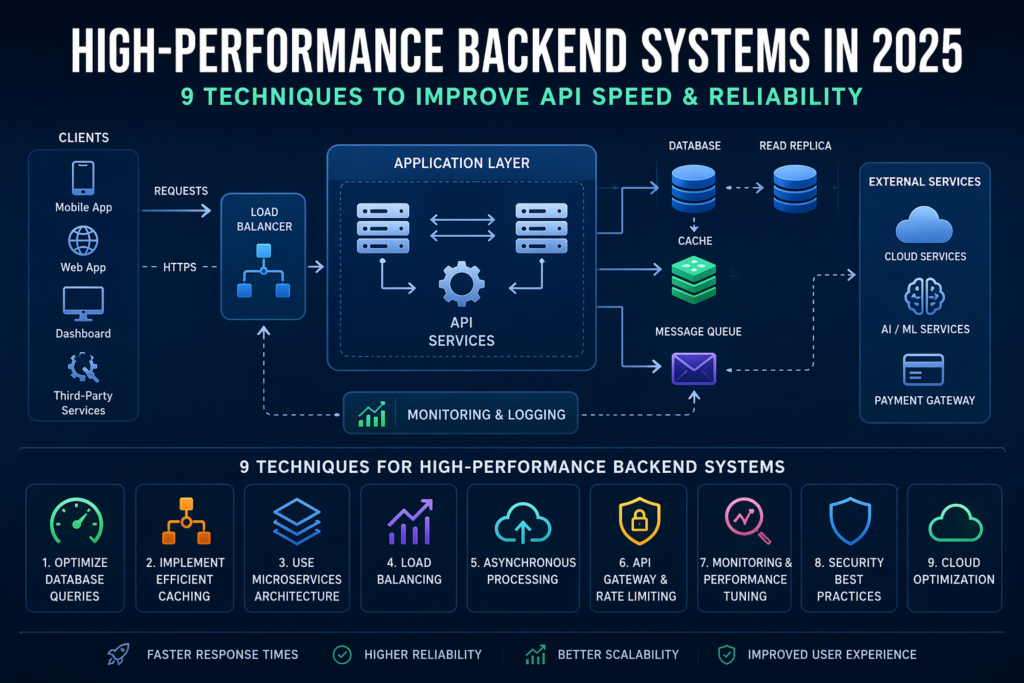
9 Techniques to Improve API Speed & Reliability
1. API Design Optimization
API design directly impacts backend performance.
A well-designed API reduces unnecessary load and improves response time.
Key improvements:
- Use REST or GraphQL based on requirements
- Avoid over-fetching and under-fetching
- Compress API responses using GZIP/Brotli
- Use proper HTTP methods
Example: Poor API design increases server load and slows down High-Performance Backend Systems in 2025 significantly.
2. Advanced Caching Strategies
Caching is one of the most powerful ways to improve backend speed.
It reduces repeated database calls and improves performance.
Types:
- Browser caching
- Server-side caching
- Database caching
- CDN caching
In real systems, Redis is widely used for caching optimization.
Caching is a core pillar of High-Performance Backend Systems in 2025.
3. Asynchronous Processing
Synchronous processing blocks system performance.
Instead, asynchronous processing improves scalability and speed.
Use it for:
- Email delivery
- Payment processing
- File uploads
- Background analytics
4. Database Optimization
Database performance is critical for backend systems.
Optimization techniques:
- Indexing frequently used columns
- Query optimization
- Read replicas
- Partitioning large datasets
Poor database design is one of the biggest bottlenecks in High-Performance Backend Systems in 2025.
5. Load Balancing
Load balancing distributes traffic across multiple servers.
Benefits:
- Prevents server overload
- Improves uptime
- Enhances scalability
- Reduces response time
This is essential for handling high traffic systems.
Load balancing ensures stable performance in High-Performance Backend Systems in 2025.
6. Microservices Architecture
Microservices break applications into independent services.
Benefits:
- Independent deployment
- Fault isolation
- Easy scaling
- Faster development
This architecture is widely used in High-Performance Backend Systems in 2025 for scalability.
7. API Rate Limiting & Throttling
Rate limiting protects backend systems from overload and abuse.
Benefits:
- Prevents API abuse
- Ensures fair usage
- Maintains system stability
Without rate limiting, even strong systems can crash under heavy traffic.
8. Infrastructure & Cloud Optimization
Cloud infrastructure plays a major role in backend performance.
Techniques:
- Auto-scaling systems
- Kubernetes orchestration
- Multi-region deployment
- High-performance instances
Cloud optimization improves both speed and cost efficiency.
9. Monitoring & Observability
Monitoring ensures long-term system reliability.
Tools:
- APM (Application Performance Monitoring)
- Logging systems
- Real-time dashboards
- Alert systems
Monitoring is essential for maintaining High-Performance Backend Systems in 2025 at scale.
Video Explanation
Here is a visual guide to understand backend architecture concepts and microservices in real-world systems.
Watch here:
Security in High-Performance Backend Systems in 2025
Security and performance must work together.
Best practices:
- OAuth 2.0 / JWT authentication
- HTTPS encryption
- Input validation
- Regular vulnerability testing (VAPT)
Secure systems are always more stable and performant.
Real-World Impact
Companies using High-Performance Backend Systems in 2025 achieve:
- Faster API response times
- Better scalability
- Lower cloud costs
- Higher uptime
- Improved user experience
Backend optimization directly impacts business success.
Conclusion
High-performance backend systems in 2025 are essential for modern applications. With increasing traffic, cloud adoption, and real-time requirements, backend optimization is a core engineering skill.
By applying these 9 techniques, developers can significantly improve API speed, reliability, and scalability.