 by
by Introduction
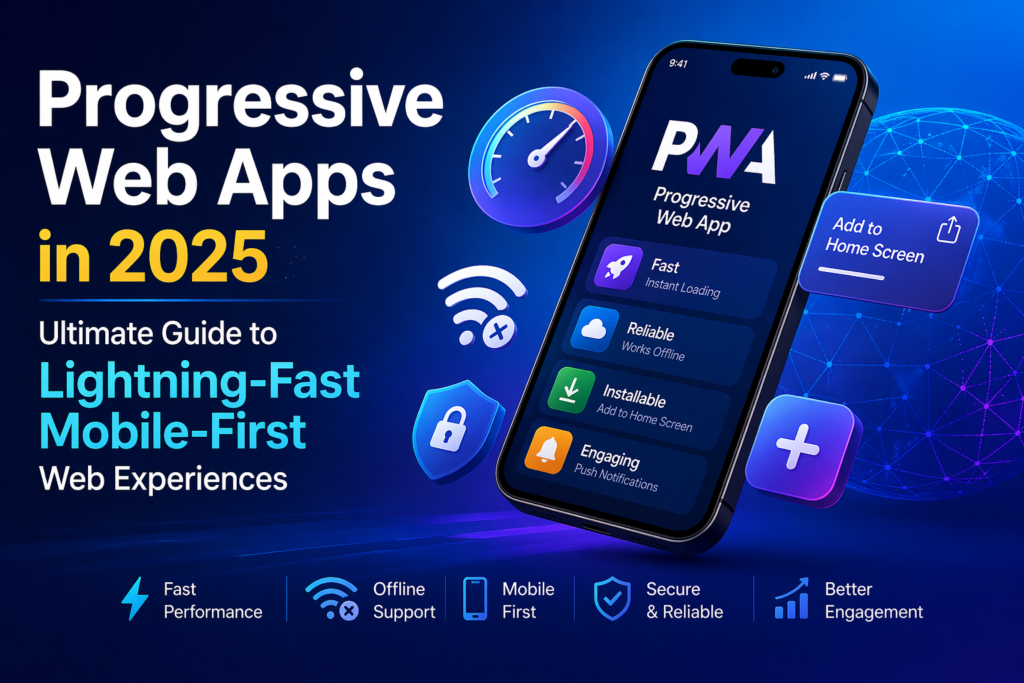
Progressive Web Apps (PWAs) in 2025 have become one of the most powerful technologies in modern web development. Businesses are shifting from traditional websites and even native apps toward PWAs because users now expect instant loading, offline access, and app-like experience directly in the browser.
With increasing mobile usage and decreasing attention span, even a 2–3 second delay can cause users to leave a website. PWAs solve this problem by combining the best features of web and mobile applications into one unified system.
In this guide, we will explore how PWAs work, why they are important in 2025, their architecture, benefits, real-world use cases, and future scope.
What Are Progressive Web Apps (PWAs)?
Progressive Web Apps are advanced web applications that behave like native mobile apps but run in a web browser.
They are built using standard web technologies like HTML, CSS, and JavaScript, but enhanced with modern capabilities such as:
- Offline functionality
- Push notifications
- Background syncing
- App-like navigation
- Installable on home screen
Unlike traditional apps, PWAs do not require installation from an app store.
Why PWAs Are Important in 2025
In 2025, user expectations are extremely high. Speed and performance are no longer optional.
PWAs solve major digital problems:
1. Speed Expectations
Users expect pages to load instantly. PWAs use caching to reduce load time drastically.
2. Mobile-First World
More than 70% traffic comes from mobile devices, making mobile-first design essential.
3. Cost Efficiency
One PWA works across Android, iOS, and desktop — reducing development cost.
4. Better Engagement
Push notifications bring users back to the platform.
5. No Installation Barrier
Users can access instantly without app store downloads.
Core Features of Progressive Web Apps
Service Workers
Service workers run in the background and handle caching, offline mode, and network requests.
Web App Manifest
This file allows users to install the app on their home screen like a native app.
Responsive Design
PWAs automatically adjust to all screen sizes and devices.
HTTPS Security
PWAs require secure connections for data protection and trust.
App Shell Architecture
The UI loads instantly while data loads separately in the background.
How PWAs Work (Technical Flow)
PWAs follow a smart architecture:
- User opens the app
- App shell loads instantly from cache
- Service worker checks for updates
- API fetches dynamic data
- Content renders without delay
This separation ensures fast first load + smooth user experience.
PWA Architecture
A modern PWA consists of:
- Frontend (UI layer)
- Service Worker (background processing)
- Cache Storage (offline data)
- API Layer (data communication)
- Backend Server (business logic)
This architecture ensures scalability and high performance.
Benefits of Progressive Web Apps
1. Lightning-Fast Performance
PWAs load instantly even on slow networks.
2. Offline Support
Users can still browse content without internet.
3. Lower Development Cost
One codebase replaces multiple native apps.
4. Higher User Retention
Push notifications increase engagement.
5. Cross-Platform Compatibility
Works on Android, iOS, Windows, and browsers.
6. SEO-Friendly
PWAs can still be indexed by Google effectively.
Progressive Web Apps vs Native Apps
| Feature | Progressive Web Apps | Native App |
| Installation | No app store needed | Required |
| Cost | Low | High |
| Performance | High | Very high |
| Updates | Automatic | Manual |
| Platform | Cross-platform | Platform-specific |
PWAs are ideal for businesses focusing on speed, cost, and scalability.
Use Cases of PWAs in 2025
1. E-Commerce Platforms
Faster loading improves conversion rates.
2. News Websites
Instant content delivery improves engagement.
3. SaaS Applications
Cloud tools benefit from fast UI and offline support.
4. Education Platforms
Students can access content offline.
5. FinTech Apps
Secure and fast transactions improve trust.
Challenges of PWAs
Even though PWAs are powerful, they still have some limitations:
- Limited iOS feature support
- Requires strong caching strategy
- Hardware access limitations
- Complex initial setup for beginners
Future of Progressive Web Apps
In 2025 and beyond, PWAs will evolve further with:
- AI-based caching systems
- Better iOS compatibility
- Deeper cloud integration
- Faster service worker execution
- Stronger offline capabilities
PWAs are expected to replace many traditional mobile applications in the future.
FAQs
1. What are Progressive Web Apps in 2025?
PWAs are web apps that behave like native apps with offline support and fast performance.
2. Are PWAs better than native apps?
PWAs are cheaper and faster to develop, but native apps may offer deeper device integration.
3. Do PWAs work offline?
Yes, PWAs use service workers for offline access.
4. Can PWAs be installed like apps?
Yes, directly from the browser without app stores.
5. Are PWAs good for SEO?
Yes, they perform well if properly optimized.
Conclusion
Progressive Web Apps in 2025 are transforming how users experience the web. With lightning-fast speed, offline capabilities, and mobile-first design, PWAs are becoming a standard choice for modern businesses.
They reduce cost, improve performance, and provide a seamless experience across all devices — making them a key technology for the future of web development.