
 by
by Introduction
API Rate Limiting and Traffic Management is essential for modern backend systems handling large-scale API requests. APIs are the backbone of modern applications. From mobile apps to web applications and cloud systems, APIs handle communication between services. But as traffic grows, managing API requests becomes critical.
Without proper API Rate Limiting and Traffic Management, backend systems can become overloaded, slow, or even crash.
In high-traffic applications, a sudden increase in API requests can impact performance, increase server costs, and reduce user experience.
This is why API rate limiting has become a critical backend strategy.
It helps control request volume, protect APIs from abuse, improve performance stability, and ensure fair resource distribution. API gateways commonly enforce rate limits to prevent overload and protect against denial-of-service patterns.
This complete guide will cover everything about API Rate Limiting and Traffic Management for scalable backend systems.
What is API Rate Limiting?
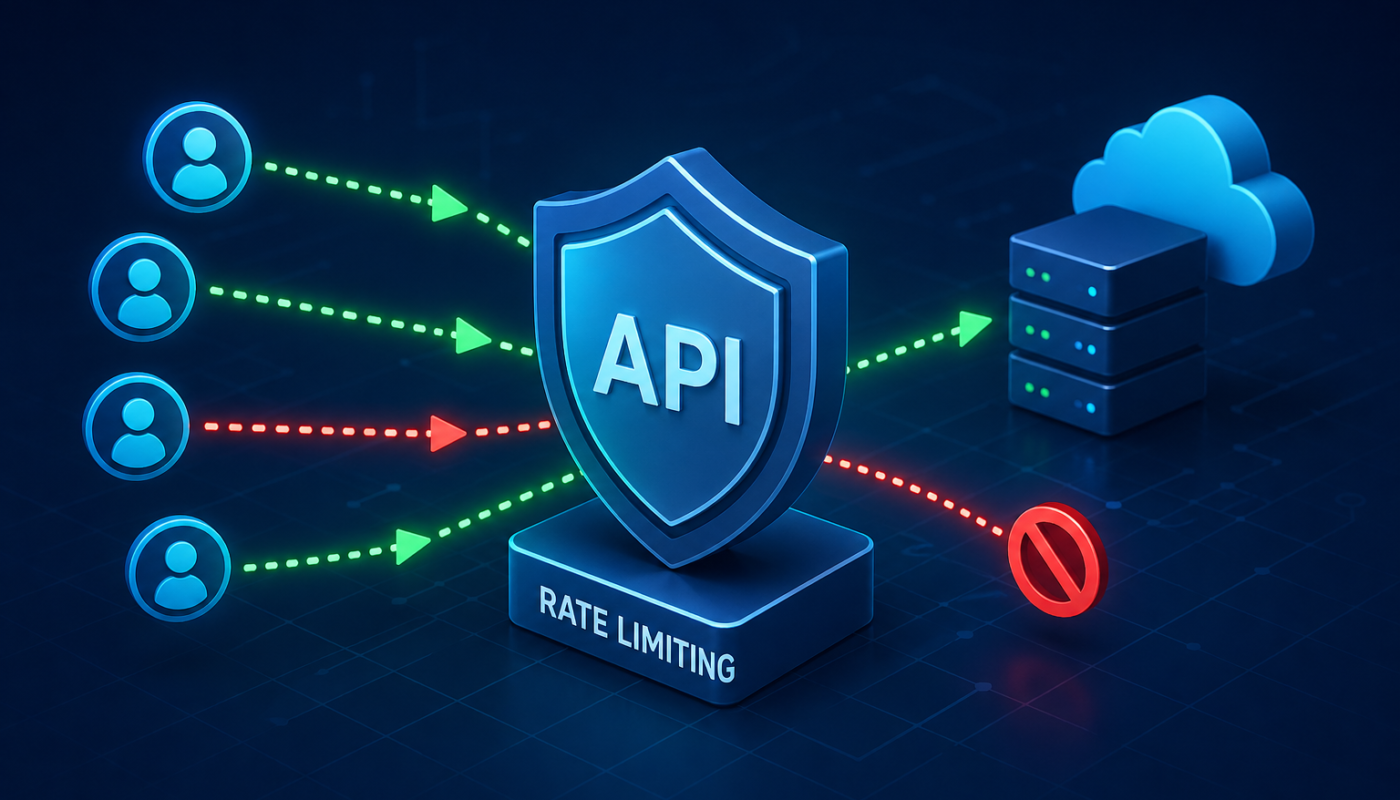
API rate limiting is the process of controlling how many requests a user, application, or IP address can make to an API within a specific time period.
Example:
- 100 requests per minute
- 1000 requests per hour
- 10 requests per second
When the limit is exceeded:
- Requests are blocked
- Requests are delayed
- Error code 429 is returned
API rate limiting protects backend resources from excessive traffic and abuse.
Why API Rate Limiting Matters
In modern systems, API Rate Limiting and Traffic Management ensures stability under high traffic loads. Backend systems face multiple challenges:
- High traffic spikes
- Bot attacks
- DDoS attempts
- Resource abuse
- Server overload
- API abuse
Without API Rate Limiting and Traffic Management:
- APIs slow down
- Databases overload
- Costs increase
- User experience drops
Rate limiting ensures fair API usage and improves system reliability.
How API Rate Limiting Works
API Rate Limiting and Traffic Management works by tracking and controlling request flow per user or system. API rate limiting tracks requests based on:
- User ID
- API key
- IP address
- Session token
Each request is counted.
If the request limit is crossed:
- The API blocks the request
- Returns HTTP 429
- Asks the client to retry later
Modern API gateways evaluate policies in real time for every request.
7 Powerful API Rate Limiting Techniques
1. Fixed Window Rate Limiting
This is the simplest rate limiting method.
Example:
100 requests per minute.
After one minute:
Counter resets.
Benefits:
- Easy implementation
- Fast processing
- Simple management
Challenges:
Traffic spikes can occur at window boundaries.
2. Sliding Window Rate Limiting
Sliding window provides better accuracy.
Instead of fixed periods, it tracks rolling requests.
Benefits:
- Better traffic control
- Improved fairness
- Reduced sudden spikes
Sliding window algorithms provide smoother enforcement than fixed windows.
3. Token Bucket Algorithm
The token bucket is highly popular.
Tokens refill continuously.
Every API request consumes one token.
Benefits:
- Allows burst traffic
- Better flexibility
- Strong scalability
Token bucket is widely used for scalable APIs.
Modern systems implement advanced controls using Rate Limiting Strategies by Google Cloud for scalable backend traffic management:
4. Leaky Bucket Algorithm
Leaky bucket smooths traffic.
Requests enter a queue.
Requests leave at a fixed speed.
Benefits:
- Prevents sudden spikes
- Smooth traffic flow
- Better backend stability
This method is useful for traffic management.
5. IP-Based Rate Limiting
Limits requests based on IP addresses.
Useful for:
- Preventing abuse
- Blocking suspicious traffic
- Managing anonymous traffic
Benefits:
- Easy setup
- Basic security
- Better protection
Best for public APIs.
6. User-Based Rate Limiting
Limits users based on account type.
Examples:
Free users → 100 requests/day
Premium users → 5000 requests/day
Benefits:
- Better monetization
- Fair resource allocation
- Controlled scaling
Perfect for SaaS APIs.
7. Endpoint-Specific Rate Limiting
Different endpoints need different limits.
Examples:
Login API → strict limit
Search API → higher limit
Benefits:
- Better optimization
- Resource efficiency
- Better security
Expensive APIs should have stricter limits.
Watch API Rate Limiting Tutorial
Traffic Management Strategies for Scalable Backend Systems
Load Balancing
Load balancing distributes traffic.
Benefits:
- Better uptime
- Better speed
- Improved scaling
Load balancing improves API stability.
Request Queuing
Queues hold excess requests.
Benefits:
- Reduced traffic spikes
- Better resource control
- Improved stability
Request queues improve backend reliability.
API Caching
Caching reduces repeated API calls.
Benefits:
- Faster response
- Lower server load
- Better performance
Caching works strongly with rate limiting.
Circuit Breakers
Stops failed services from affecting the system.
Benefits:
- Better fault isolation
- Reduced failures
- Better backend recovery
Useful in microservices.
API Gateway Management
API gateways control:
- Rate limiting
- Authentication
- Traffic routing
- Monitoring
API gateways are critical for scalable systems. Modern systems heavily rely on API Gateway Management in Cloud Systems for centralized traffic control and security enforcement.
Best Practices for API Rate Limiting and Traffic Management
Proper implementation of API Rate Limiting and Traffic Management improves system reliability and scalability.
Define Smart Limits
Set realistic limits.
Avoid overly strict rules.
Use Distributed Rate Limiting
Distributed systems need centralized tracking.
Use cache systems for request counters.
Monitor Traffic Patterns
Track:
- Traffic spikes
- Blocked requests
- Response times
Monitoring improves optimization.
Return Clear Error Messages
Use proper 429 responses.
Help developers understand limits.
Combine Rate Limiting with Security
Rate limiting improves API security.
It helps stop abuse and attacks.
For enterprise-level API management, AWS provides detailed guidance on API throttling and traffic control in AWS API Gateway Request Throttling Best Practices.
Common Challenges in API Rate Limiting
False Blocking
Legitimate users may hit limits.
Solution:
Smart thresholds.
Distributed System Complexity
Tracking across multiple servers is difficult.
Solution:
Centralized counters.
Performance Overhead
Rate limiting adds processing.
Solution:
Use fast in-memory systems.
Dynamic Traffic Patterns
Traffic changes constantly.
Solution:
Adaptive rate limiting.
These challenges are directly connected with Modern Web Scalability, where systems must handle unpredictable traffic loads efficiently.
Future of API Rate Limiting
API traffic is growing rapidly.
Future trends:
AI-Based Traffic Prediction
AI will predict spikes.
Smart Dynamic Limits
Limits will adjust automatically.
Better Bot Detection
Traffic filtering will improve.
Stronger API Security
Security-driven rate limiting will expand.
Cloud-Native API Management
Cloud-native API gateways will improve scalability.
The future of API Rate Limiting and Traffic Management is intelligent and automated.
Conclusion
API Rate Limiting and Traffic Management are essential for scalable backend systems. API Rate Limiting and Traffic Management is a critical strategy for scalable backend architecture.
Without proper rate limiting:
- APIs fail
- Costs rise
- User experience suffers
By implementing:
- Fixed window
- Sliding window
- Token bucket
- Leaky bucket
- IP-based limits
- User-based limits
- Endpoint-based limits
businesses can improve API performance, reduce overload, and scale efficiently.
Strong traffic management ensures backend stability in modern applications.