 by
by Introduction
In 2025, digital applications are expected to be ultra-fast, always available, and highly scalable. Users don’t wait more than a few seconds for a page to load or an API to respond. This is why Application Performance Monitoring (APM) has become one of the most critical components in modern software architecture.
APM is not just about checking if an application is running—it is about understanding how well it is performing under real-world conditions, identifying bottlenecks instantly, and ensuring that every user interaction is smooth.
With cloud-native systems, microservices, and distributed databases becoming standard, monitoring has evolved into a full-scale observability ecosystem.
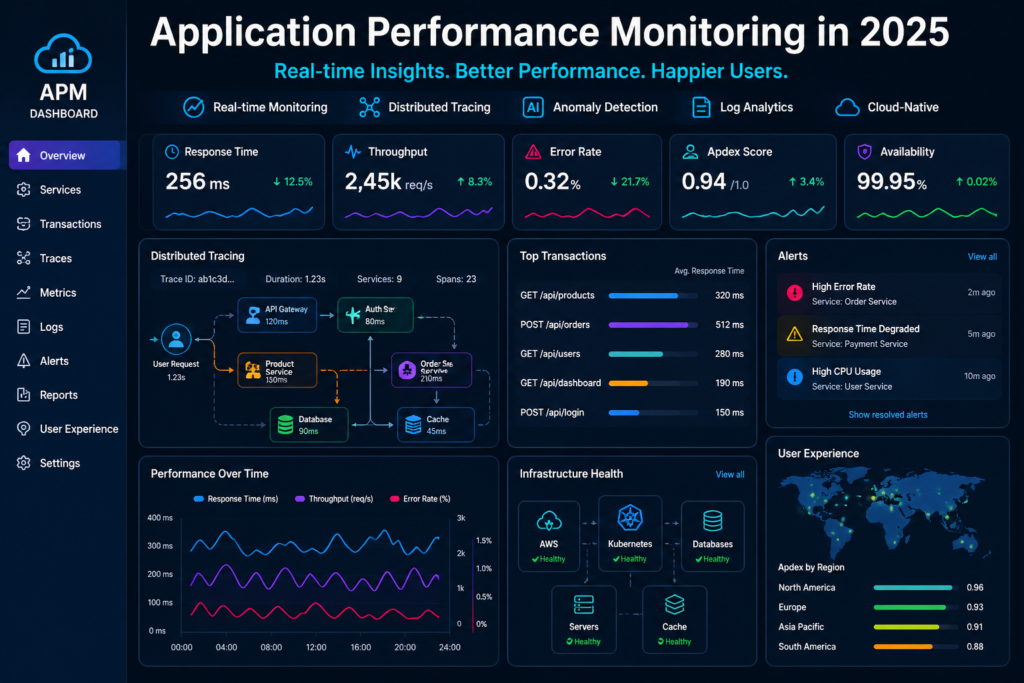
What is Application Performance Monitoring (APM)?
Application Performance Monitoring is a practice of tracking, analyzing, and optimizing application performance in real time.
It focuses on:
- Application speed and responsiveness
- Backend service performance
- API latency and error rates
- Infrastructure health
- User experience metrics
APM ensures that developers and DevOps teams can detect and fix performance issues before users are impacted.
Why APM is Important
Modern applications are complex systems made up of many interconnected parts. A single user request may travel through:
- Frontend UI
- API gateway
- Microservices
- Databases
- External third-party APIs
If even one component slows down, the entire system can suffer.
Key reasons APM is essential today:
- Increasing demand for real-time applications
- Cloud-native distributed systems
- High user expectations
- Microservices complexity
- Revenue loss due to downtime
Powerful Techniques for Application Performance Monitoring
1. End-to-End Distributed Tracing
Distributed tracing allows tracking of a single request across multiple services.
It helps identify:
- Slow microservices
- Bottleneck APIs
- Hidden latency issues
This technique is essential for microservices-based systems where requests pass through multiple layers.
2. Real-Time Metrics Monitoring
Real-time metrics provide instant visibility into system health. Open-source tools like Prometheus Monitoring System are widely used for real-time metrics collection in modern applications.
Key metrics include:
- CPU usage
- Memory consumption
- Request latency
- Error rates
- Throughput
Real-time dashboards help teams respond immediately to performance degradation.
3. Log Aggregation with Intelligent Analysis
Modern applications generate massive logs across different services. Modern monitoring systems also integrate with Security Logging and Event Correlation for advanced threat detection and system visibility.
Log aggregation systems:
- Collect logs from all services
- Centralize them into one system
- Use AI to detect patterns and anomalies
This significantly reduces debugging time and improves troubleshooting efficiency.
4. User Experience Monitoring (RUM)
Real User Monitoring tracks actual user behavior in real-time.
It focuses on:
- Page load speed
- Interaction delays
- Device performance
- Geographic performance differences
RUM ensures optimization is based on real user experience, not just server metrics.
5. AI-Powered Anomaly Detection
AI is transforming APM by automatically detecting unusual patterns.
It can identify:
- Sudden traffic spikes
- Memory leaks
- API failure trends
- Abnormal latency increases
This proactive approach helps prevent system outages before they occur.
6. Dependency Mapping and Service Graphs
Modern systems depend on multiple interconnected services.
Dependency mapping provides:
- Visual representation of service relationships
- Impact analysis during failures
- Root cause identification
This is crucial in complex microservice architectures.
7. Synthetic Monitoring
Synthetic monitoring simulates user actions using automated scripts.
It tests:
- Login flows
- API endpoints
- Checkout systems
- Search functionality
This ensures system reliability even when real users are not actively using the application.
8. Cloud-Native Observability Integration
In 2025, most applications run in cloud environments. APM tools play a key role in Modern Web Scalability, ensuring systems handle high traffic without performance loss.
APM tools now integrate with:
- Kubernetes clusters
- Docker containers
- Serverless functions
This provides dynamic and scalable monitoring across infrastructure.
9. Performance Baseline Tracking
Baseline monitoring compares current performance with historical data.
It helps detect:
- Performance degradation
- System slowdowns over time
- Infrastructure inefficiencies
This ensures continuous optimization of applications.
Benefits of Application Performance Monitoring
Implementing strong APM strategies delivers:
- Faster application response times
- Improved system reliability
- Reduced downtime
- Better user experience
- Data-driven performance optimization
Challenges in APM Implementation
Even with advanced tools, organizations face challenges like:
- High data volume from logs and metrics
- Complex microservices architecture
- False alerts and noise
- Tool integration difficulties
Proper configuration and AI-based filtering help solve these issues.
Best Practices for APM
To maximize results:
- Use centralized observability platforms
- Combine logs, metrics, and traces
- Implement AI-based alerting
- Continuously update performance baselines
- Monitor both frontend and backend systems
Future of Application Performance Monitoring
The future of APM is moving toward:
- Fully AI-driven monitoring systems
- Predictive performance analytics
- Self-healing applications
- Zero-downtime architectures
In the coming years, APM will evolve into autonomous performance optimization systems.
Complete Guide to Application Performance Monitoring
Conclusion
Application Performance Monitoring in 2025 is no longer optional—it is a core requirement for building fast, scalable, and reliable systems. With increasing system complexity, organizations must adopt advanced monitoring techniques like distributed tracing, AI-based anomaly detection, and cloud-native observability.
Businesses that invest in modern APM strategies will gain better performance, improved user satisfaction, and long-term system stability.