
 by
by Introduction
Modern enterprises are rapidly evolving toward scalable, cloud-native, and real-time architectures, where modern data system modernization has become the backbone of digital growth. Organizations dealing with large-scale systems must upgrade their pipelines, storage, and processing frameworks to handle massive volumes of structured and unstructured data efficiently.
Data Engineering Transformation is becoming essential for enterprises that want faster insights, better decision-making, and high system reliability. In today’s big systems, companies are focusing on automation, distributed computing, and real-time data flows to stay competitive.
This guide explains how modern data system modernization helps big systems evolve from traditional batch-based pipelines to intelligent, real-time, and scalable data ecosystems..

What is Data Engineering Transformation?
Data Engineering Transformation refers to the process of modernizing data infrastructure, pipelines, and processing systems to handle large-scale, complex, and real-time data efficiently.
This evolution is closely connected with modern Big Data Tools used in enterprise environments.
It involves shifting from legacy ETL systems to modern ELT, cloud-native platforms, and distributed processing frameworks.
The goal of Data Engineering Transformation is to make data:
- Faster to process
- Easier to access
- More scalable
- More reliable
In big systems, this transformation ensures that data flows smoothly from ingestion to analytics without bottlenecks.
Why Data Engineering Transformation is Important
Enterprises generate massive data every second from apps, IoT devices, transactions, and APIs. Without transformation, systems become slow and inefficient.
These improvements are widely used in modern systems where AI in Cybersecurity plays a major role in detecting threats, analyzing data patterns, and improving real-time decision-making.
Key reasons why Data Engineering Transformation is critical:
- Supports real-time analytics
- Improves system scalability
- Reduces infrastructure cost
- Enhances data quality and governance
- Enables AI and machine learning readiness
Modern businesses rely heavily on this modernization to stay competitive in data-driven markets.
Core Components of Modern Data Systems
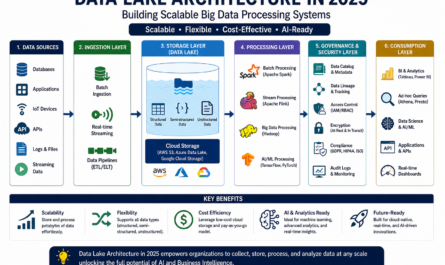
A successful Data Engineering Transformation strategy includes several layers:
1. Data Ingestion Layer
Handles data collection from multiple sources like APIs, databases, and streaming platforms.
2. Data Processing Layer
Uses distributed frameworks for batch and real-time processing.
3. Data Storage Layer
Includes data lakes and cloud warehouses for scalable storage.
4. Orchestration Layer
Automates workflows and pipeline scheduling.
5. Analytics Layer
Supports BI tools, dashboards, and machine learning models.
Together, these layers form the backbone of Data Engineering Transformation in big systems.
Modern Architecture for Big Systems
Modern data systems are built using cloud-native and distributed architectures.
Common architectures used in Data Engineering Transformation:
- Lambda Architecture (batch + streaming hybrid)
- Kappa Architecture (streaming-first model)
- Lakehouse Architecture (combines warehouse + data lake)
These architectures ensure high scalability, fault tolerance, and real-time processing capabilities.
ETL to ELT Evolution
Traditional ETL (Extract, Transform, Load) is being replaced by ELT (Extract, Load, Transform).
In Data Engineering Transformation, ELT plays a major role because:
- Data is loaded first into storage
- Transformations happen using cloud compute
- Processing becomes faster and more flexible
This shift significantly improves performance in big systems.
Cloud-Native Data Engineering
Cloud platforms have completely changed how modern data systems are implemented.
Key benefits of cloud-native systems:
- Elastic scalability
- Reduced infrastructure management
- Pay-as-you-go cost model
- High availability and security
Cloud tools like AWS, Azure, and Google Cloud are widely used in modern transformation strategies.
Real-Time Data Processing
Real-time processing is now a core requirement in modern systems.
Technologies used include:
- Apache Kafka
- Apache Flink
- Spark Streaming
Benefits:
- Instant analytics
- Faster decision-making
- Improved user experience
Real-time pipelines are essential for industries like fintech, e-commerce, and IoT systems.
Tools Used in Data Engineering Transformation
Modern Data Engineering Transformation uses powerful tools such as:
- Apache Spark
- Apache Kafka
- Snowflake
- Databricks
- Apache Airflow
These tools help build scalable and efficient data pipelines in big systems.
Best Practices for Transformation
To successfully implement Data Engineering Transformation, follow these best practices:
- Design scalable pipelines
- Automate data workflows
- Implement strong data governance
- Monitor data quality continuously
- Use CI/CD for data pipelines
These practices ensure long-term stability and performance.
Challenges in Data Engineering Transformation
Despite its benefits, Data Engineering Transformation comes with challenges:
- Legacy system integration
- High migration costs
- Data silos across departments
- Skill shortages
- Security and compliance issues
Proper planning and phased migration can help overcome these challenges.
Future of Data Engineering Transformation
The future of Data Engineering Transformation is moving toward automation and intelligence.
Upcoming trends:
- AI-driven data pipelines
- Serverless data architecture
- Self-healing systems
- Edge data processing
- Fully automated ETL/ELT workflows
These advancements will make big systems more efficient and autonomous.
YouTube Learning Resource
Watch this to understand modern data engineering concepts:
Conclusion
Data Engineering Transformation is the foundation of modern big data systems. It enables organizations to build scalable, real-time, and intelligent data ecosystems.
From cloud-native architecture to real-time streaming, every component plays a critical role in system performance and business intelligence.
By adopting Data Engineering Transformation, enterprises can future-proof their data infrastructure and unlock powerful insights for growth and innovation.