 by
by Introduction
In 2025, modern applications no longer rely on traditional batch processing systems. Instead, they depend on real-time data streaming systems that process millions of events instantly.
From financial fraud detection to live recommendation engines, real-time streaming enables businesses to react within milliseconds. Real-Time Data Streaming Systems in 2025 are transforming how modern applications process data in real time.
Companies like Netflix, Uber, Amazon, and fintech platforms rely heavily on streaming architectures to deliver fast, intelligent, and scalable systems.
This guide explains everything about real-time data streaming systems in 2025, including architecture, tools, techniques, and real-world applications.
What Are Real-Time Data Streaming Systems?
Real-time data streaming systems continuously process data as it is generated instead of storing and processing it later.
Key idea:
Data is processed event-by-event in real time.
Data sources include:
- User clicks on websites/apps
- Payment transactions
- IoT sensor data
- Server logs
- Social media activity
Instead of waiting for batch processing, systems respond immediately.
Why Real-Time Streaming Matters
Modern digital systems require instant decision-making:
Examples:
- Fraud detection in banking (block transaction instantly)
- E-commerce recommendations (Amazon-style suggestions)
- Ride matching (Uber/Lyft)
- Cybersecurity threat detection
Benefits:
- Ultra-low latency processing
- Real-time decision making
- Better user experience
- Scalable distributed systems
Real-Time Data Streaming Architecture
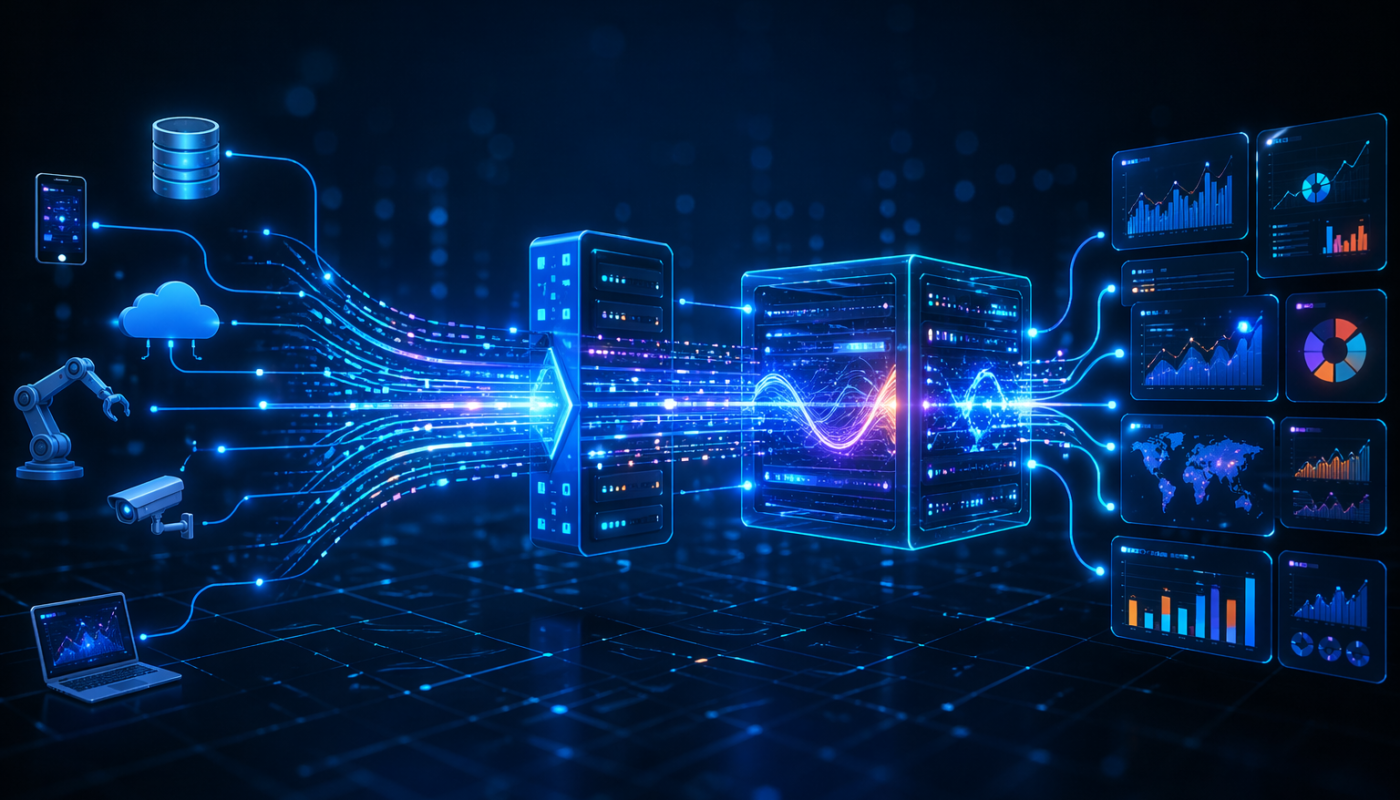
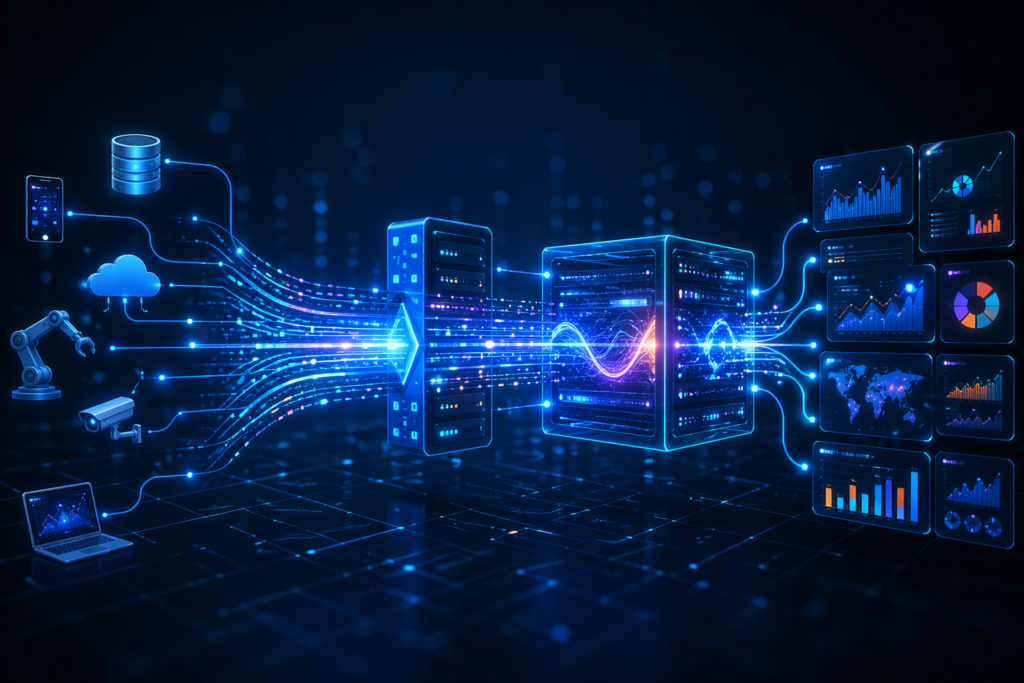
Understanding Real-Time Data Streaming Systems in 2025 requires a strong grasp of distributed architecture. A typical modern streaming system follows this architecture:
Pipeline Flow:
Producers → Event Broker → Stream Processing Engine → Storage/Consumers
1 Producers
These generate data:
- Mobile apps
- Web applications
- IoT devices
2 Event Broker (Messaging Layer)
This handles data flow:
Popular tools:
- Apache Kafka
- Apache Pulsar
Role:
- Stores streaming events
- Ensures fault tolerance
- Handles high throughput
3 Stream Processing Engine
This is the brain of the system:
Popular tools:
- Apache Flink
- Spark Streaming
Role:
- Real-time computation
- Filtering & aggregation
- Event transformation
4 Storage & Consumers
Processed data is sent to:
- Databases (PostgreSQL, MongoDB)
- Data lakes (S3, Hadoop)
- Dashboards (Grafana, Kibana)
Apache Kafka: Backbone of Streaming Systems
Apache Kafka is the most widely used event streaming platform in 2025.
Key features:
- Handles millions of events per second
- Distributed and fault-tolerant
- Durable message storage
- Horizontal scalability
Why Kafka is important:
- Decouples systems
- Enables microservices communication
- Acts as central event hub
Kafka is the foundation of most real-time architectures today.
Apache Flink: Advanced Stream Processing Engine
Apache Flink is a powerful stream processing framework used for real-time analytics.
Key capabilities:
- Event-time processing
- Stateful computations
- Exactly-once processing
- Low latency (< milliseconds)
Use cases:
- Fraud detection systems
- Real-time analytics dashboards
- Monitoring systems
- AI-driven pipelines
Advanced Streaming Concepts in 2025
Event-Time Processing
Processing based on when the event actually happened, not when received.
Stateful Processing
System remembers past events for complex calculations.
Windowing
Events grouped into time windows:
- Tumbling windows
- Sliding windows
- Session windows
Exactly-Once Processing
Ensures no duplicate or lost events.
Real-World Use Cases
Financial Fraud Detection
Banks analyze transactions in real time to detect suspicious activity instantly.
E-commerce Personalization
Platforms like Amazon suggest products based on live behavior.
Ride Sharing Apps
Uber matches drivers and riders in real time.
Cybersecurity Monitoring
Detect attacks and anomalies instantly in network traffic using threat detection systems.
IoT Systems
Smart devices send continuous sensor data for real-time monitoring, which depends on low-latency data processing systems.
Kafka vs Flink
| Feature | Kafka | Flink |
| Role | Event streaming platform | Stream processing engine |
| Function | Data transport | Data computation |
| Processing | No processing | Advanced processing |
| Latency | Low | Ultra-low |
| Use case | Messaging backbone | Real-time analytics |
They are not competitors — they work together.
Challenges in Real-Time Streaming Systems
Even in 2025, challenges remain:
1 Data spikes
Sudden traffic bursts can overload systems.
2 State management
Maintaining consistent state across distributed systems is complex.
3 Latency control
Keeping processing under milliseconds is difficult at scale.
4 Fault tolerance
Systems must recover without data loss.
Future of Real-Time Data Streaming
The future is moving toward:
AI-Native Streaming
AI automatically optimizes pipelines.
Edge + Cloud Hybrid Systems
Processing happens closer to users.
Autonomous Data Pipelines
Self-healing and self-scaling systems.
Real-Time AI Decision Systems
Streaming data directly powers AI models.
Conclusion
Real-Time Data Streaming Systems in 2025 are essential for building scalable modern applications. Real-time data streaming systems in 2025 are the foundation of modern digital infrastructure.
With tools like Kafka and Flink, businesses can build:
- Scalable systems
- Low-latency pipelines
- Intelligent real-time applications
Companies that adopt streaming architecture will lead the next generation of digital transformation.They are not competitors — they work together.