 by
by Introduction
Kubernetes Cluster Optimization in 2025 is essential for managing scalable containerized environments in modern cloud systems. Kubernetes has become the foundation of modern cloud-native infrastructure in 2025. Almost every scalable application today runs on containerized environments orchestrated by Kubernetes. Organizations across industries—fintech, e-commerce, SaaS, and enterprise IT—rely heavily on Kubernetes to deploy microservices, manage APIs, and handle large-scale distributed workloads.
However, as adoption increases, so does complexity. Many organizations face issues like inefficient resource usage, high cloud costs, slow application performance, and unstable clusters. These problems usually occur when Kubernetes is deployed but not properly optimized.
Kubernetes cluster optimization is the process of tuning and improving cluster performance, scalability, and cost efficiency. In 2025, optimization is no longer optional—it is a core requirement for maintaining stable and high-performing systems.
This blog provides a complete deep dive into Kubernetes cluster optimization techniques, challenges, real-world strategies, and future trends.
What is Kubernetes Cluster Optimization?
Kubernetes Cluster Optimization in 2025 focuses on improving resource usage and system efficiency. Kubernetes cluster optimization refers to improving how a cluster uses compute, memory, storage, and network resources to run applications efficiently.
It ensures:
- Maximum resource utilization
- Minimum downtime
- Faster deployment cycles
- Stable workload execution
- Cost-effective infrastructure usage
In simple terms, it makes Kubernetes faster, smarter, and more efficient.
Why Kubernetes Optimization is Critical in 2025
In 2025, Kubernetes optimization is critical for reducing cloud costs and improving system performance. Modern applications are no longer simple monoliths. They are:
- Microservices-based
- API-driven
- Cloud-native
- Event-driven
- Distributed across multiple environments
Without optimization, clusters face serious challenges:
Major Issues:
- Increased cloud expenses
- Pod crashes under heavy load
- Slow response times
- Uneven resource allocation
- Scaling failures during traffic spikes
Benefits of Optimization:
- Better performance stability
- Reduced infrastructure cost
- Efficient scaling
- Faster deployment pipelines
- Improved user experience
Core Kubernetes Optimization Strategies
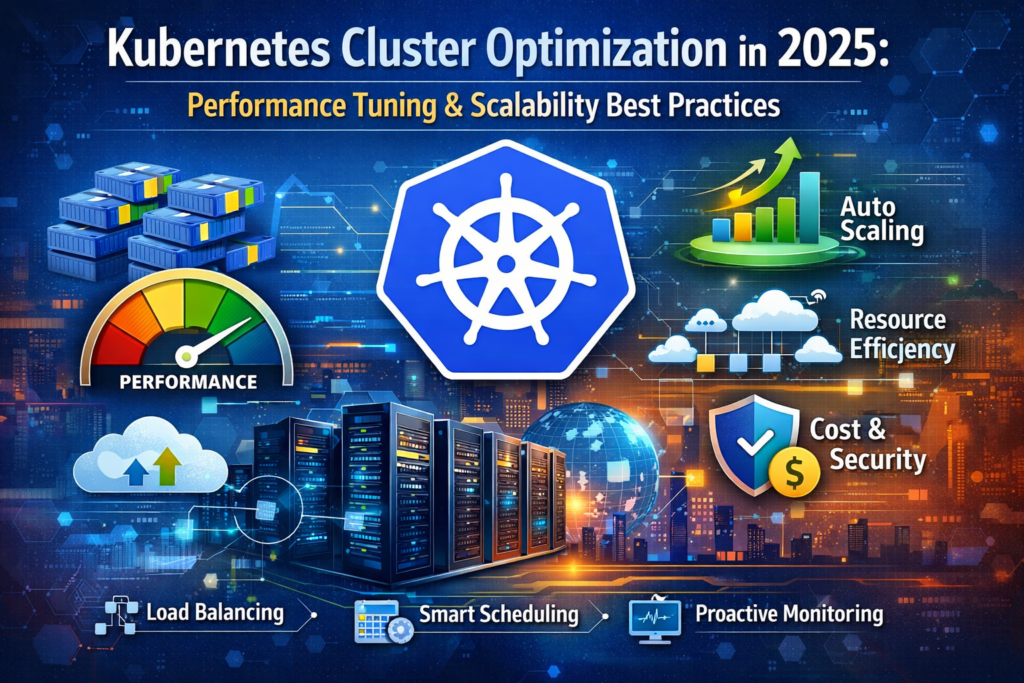
Kubernetes Cluster Optimization in 2025 helps teams manage scaling and workload distribution efficiently.
1. Resource Requests and Limits Tuning
Each container must define CPU and memory requests and limits.
If not configured properly:
- Some pods consume too much resource
- Others starve and crash
Proper tuning ensures:
- Balanced resource allocation
- Cluster stability
- Predictable performance
2. Horizontal Pod Autoscaling (HPA)
HPA automatically adjusts pod count based on CPU or custom metrics.
Advantages:
- Handles traffic spikes
- Improves availability
- Reduces manual intervention
Example:
An e-commerce website automatically scales during a flash sale.
3. Cluster Autoscaler Optimization
Cluster autoscaler dynamically adds or removes nodes.
Benefits:
- Cost optimization
- Efficient workload distribution
- Prevents over-provisioning
This is essential for cloud cost control in 2025.
4. Efficient Scheduling Strategies
Kubernetes scheduler decides where pods run.
Techniques:
- Node affinity (assign pods to specific nodes)
- Taints & tolerations (restrict workloads)
- Pod anti-affinity (avoid conflicts)
This improves performance distribution across nodes.
5. Network Optimization in Kubernetes
Networking is a major performance factor.
Improvements:
- Use optimized CNI plugins
- Reduce cross-node communication
- Optimize service mesh configuration
- Minimize latency between microservices
Poor network design directly impacts application speed.
6. Container Image Optimization
Large container images slow down deployments.
Best practices:
- Use lightweight base images (Alpine, Distroless)
- Remove unnecessary libraries
- Use multi-stage builds
- Reduce image layers
Smaller images = faster deployment + scaling.
7. Monitoring & Observability
Without monitoring, optimization is impossible.
Tools:
- Prometheus
- Grafana
- Kubernetes Dashboard
- ELK Stack
Metrics to track:
- CPU usage
- Memory consumption
- Latency
- Pod restarts
- Node health
Monitoring helps detect bottlenecks early.
8. Load Balancing Optimization
Load balancing ensures traffic is distributed evenly across pods.
Benefits:
- Prevents overload on single pod
- Improves response time
- Enhances system stability
9. Storage Optimization
Storage plays a key role in performance.
Techniques:
- Use SSD-backed storage
- Optimize persistent volumes
- Remove unused storage claims
- Use dynamic provisioning
10. Security-Aware Optimization
Security directly impacts performance and stability.
Practices:
- RBAC (Role-Based Access Control)
- Secure API access
- Encryption between services
- Secret management
Comparison Table: Optimized vs Non-Optimized Kubernetes
| Feature | Optimized Cluster | Non-Optimized Cluster |
| Performance | High & stable | Slow & inconsistent |
| Cost | Low | High |
| Scaling | Automatic | Manual / broken |
| Resource Usage | Efficient | Wasted |
| Downtime | Minimal | Frequent |
Challenges in Kubernetes Optimization
Even with best practices, challenges exist:
- Complex configuration management
- Debugging distributed systems
- Over-provisioning resources
- Lack of visibility
- Skill gaps in DevOps teams
Future of Kubernetes Optimization
Future systems will include:
- AI-based autoscaling
- Predictive workload management
- Self-healing clusters
- Fully automated performance tuning
- Intelligent cost optimization
FAQs
Q1. What is Kubernetes cluster optimization?
It is the process of improving performance, scaling, and cost efficiency of Kubernetes systems.
Q2. Why is it important in 2025?
Because modern cloud systems are complex, distributed, and cost-sensitive.
Q3. What is the biggest issue in Kubernetes?
Poor resource allocation and lack of monitoring.
Q4. Which tools are best for Kubernetes monitoring?
Prometheus, Grafana, and ELK stack.
Conclusion
Kubernetes Cluster Optimization in 2025 ensures high performance, scalability, and cost efficiency in modern cloud-native systems. Kubernetes cluster optimization is essential for building high-performance, scalable, and cost-efficient cloud-native systems in 2025. Without proper tuning, even the most powerful infrastructure can become expensive and unstable.
Kubernetes Cluster Optimization in 2025 ensures high performance, scalability, and cost efficiency in modern cloud-native systems. By implementing autoscaling, resource optimization, monitoring, and intelligent scheduling, organizations can achieve highly stable and efficient Kubernetes environments.
In the future, AI-driven Kubernetes systems will eliminate most manual optimization tasks and make infrastructure fully autonomous.




One thought on “Kubernetes Cluster Optimization in 2025: Performance Tuning and Scalability Best Practices”