
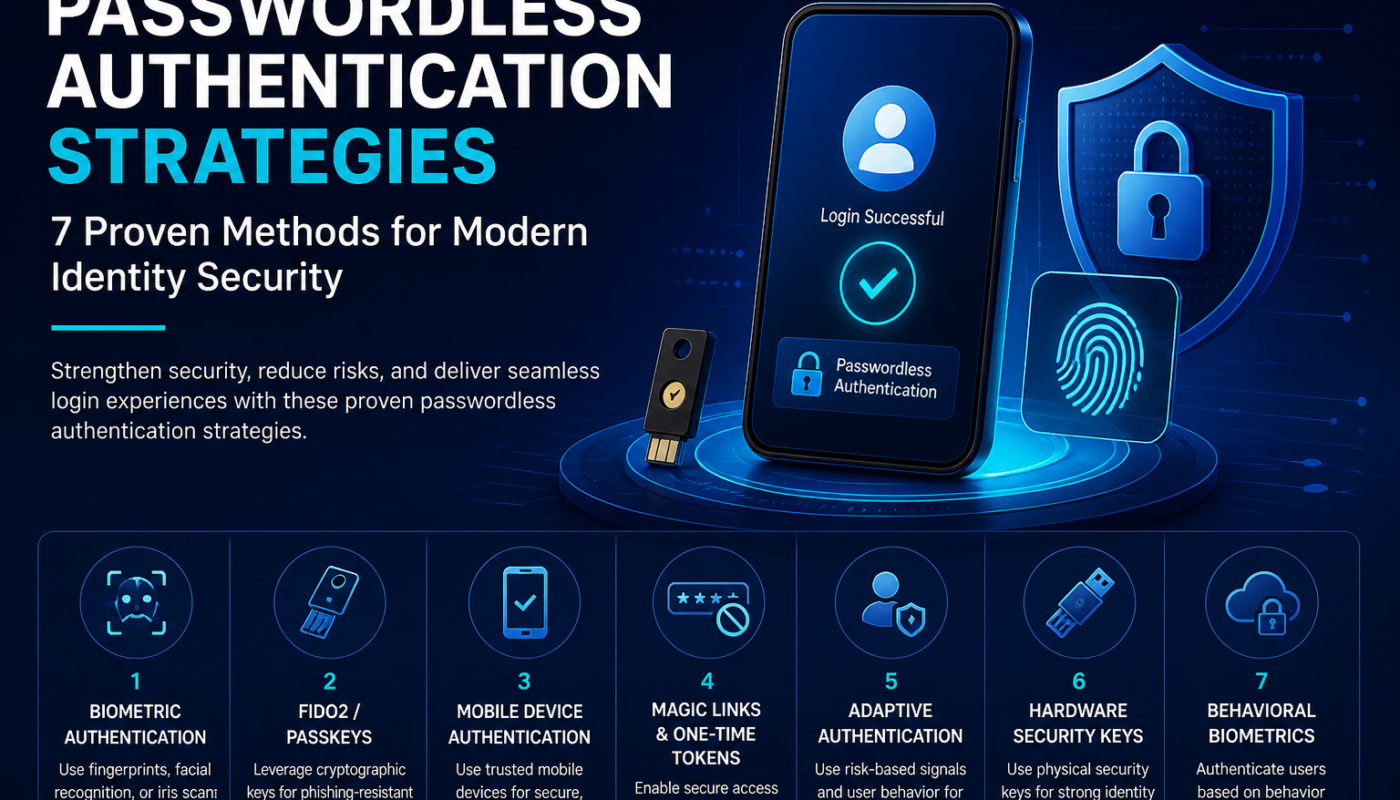
 by
by Introduction
Passwordless Authentication Strategies are becoming a critical part of modern identity security as organizations move away from traditional password-based systems. Password-based authentication has been the backbone of digital security for decades, but it is now one of the weakest points in modern cybersecurity systems. Organizations across the world are facing increasing cyberattacks such as phishing, credential stuffing, brute-force attacks, and password leaks. The main reason behind these attacks is simple: passwords are easy to guess, reuse, steal, or crack.
As digital transformation accelerates, businesses are moving toward more secure and user-friendly authentication methods. Passwordless authentication is emerging as a powerful solution that eliminates the need for traditional passwords entirely. Instead, it uses advanced identity verification techniques such as biometrics, security keys, device trust, and cryptographic authentication.
This approach not only improves security but also enhances user experience by removing the burden of remembering and managing passwords. In this detailed guide, we will explore what passwordless authentication is, why it is important, and seven proven strategies that organizations can implement to strengthen modern identity security.
What is Passwordless Authentication?
Passwordless Authentication Strategies refer to authentication methods that remove the need for passwords. Passwordless authentication is a modern identity verification method that allows users to log into systems, applications, or devices without entering a password. Instead of relying on something the user knows, it uses stronger authentication factors such as something the user has or something the user is.
These factors include:
- Biometrics (fingerprint, face recognition, iris scan)
- Hardware security keys
- Mobile authentication apps
- Trusted devices
- Cryptographic tokens
The goal of passwordless authentication is to remove the risks associated with passwords and replace them with stronger, more secure identity verification mechanisms. These Passwordless Authentication Strategies are widely used in modern authentication systems like Identity and Access Management (IAM).
Unlike traditional authentication systems, passwordless methods are designed to reduce human error, eliminate password reuse, and prevent credential-based attacks.
Why Passwordless Authentication is Important
Passwordless Authentication Strategies are important because traditional passwords are highly vulnerable. Passwordless authentication has become a critical requirement in modern cybersecurity because traditional password systems are no longer secure enough.
1. Weak and Reused Passwords
Most users reuse the same password across multiple platforms. If one system is breached, attackers can access multiple accounts.
2. Phishing Attacks
Cybercriminals use fake websites and emails to trick users into entering their passwords. Once stolen, these credentials are used for unauthorized access.
3. Credential Stuffing
Hackers use leaked password databases to try logging into multiple systems, exploiting users who reuse passwords.
4. High Maintenance Costs
Organizations spend significant resources on password resets, recovery systems, and helpdesk support.
5. Poor User Experience
Users often struggle to remember complex passwords, leading to frustration and weak password practices.
By eliminating passwords completely, organizations can reduce these risks while improving both security and user experience.
This is why Passwordless Authentication Strategies are essential for modern security systems.
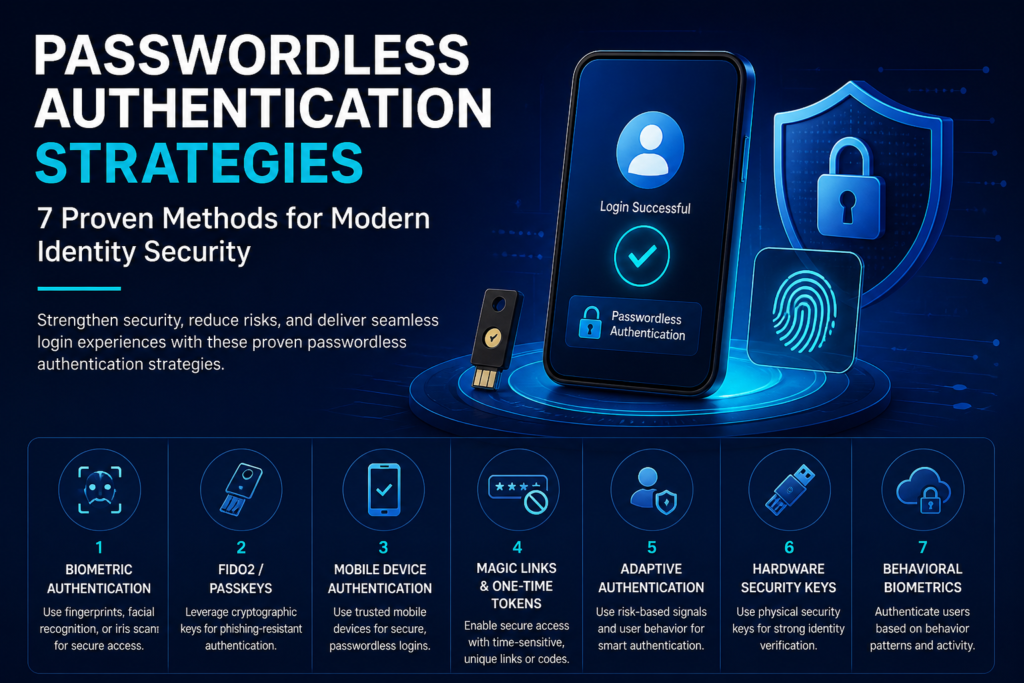
Key Passwordless Authentication Strategies
1 Biometric Authentication for Strong Identity Verification
Biometric authentication is one of the most widely used passwordless methods because it relies on unique human characteristics that are extremely difficult to replicate. Passwordless Authentication Strategies using biometric authentication improve identity security.
It includes:
- Fingerprint recognition
- Facial recognition
- Voice recognition
- Iris scanning
Biometrics improve security by ensuring that only the legitimate user can access the system. Since biometric data is tied to physical identity, it significantly reduces the risk of unauthorized access.
However, organizations must ensure that biometric data is securely encrypted and stored to prevent misuse or breaches.
2 FIDO2 Security Keys for Advanced Protection
FIDO2 (Fast Identity Online) security keys provide one of the strongest forms of passwordless authentication. Passwordless Authentication Strategies with FIDO2 security keys provide strong phishing protection. FIDO2-based Passwordless Authentication Strategies align with the zero trust security model for stronger protection.
Instead of passwords, users authenticate using a physical security key or built-in device authentication.
Key benefits include:
- Strong resistance to phishing attacks
- Cryptographic authentication protection
- No shared secrets stored on servers
- Fast and secure login process
FIDO2 is widely used in enterprise environments where high security is required. Since authentication requires physical possession of a device, it becomes extremely difficult for attackers to compromise accounts remotely.
3 Magic Link Authentication for Seamless Access
Magic link authentication allows users to log in by clicking a secure link sent to their registered email address.
Once clicked, the user is automatically authenticated without entering a password.
Advantages include:
- Simple and user-friendly login process
- No need to remember passwords
- Reduced password-related security risks
- Faster onboarding experience
This method is commonly used in SaaS platforms, subscription services, and customer portals where ease of access is important.
However, it is important to secure email accounts since they become the authentication gateway.
4 Device-Based Authentication for Trusted Access
Device-based authentication verifies users based on trusted devices that have been previously registered.
This method ensures that only approved devices can access sensitive systems. Passwordless Authentication Strategies based on device trust enhance secure access.
It uses:
- Device certificates
- Trusted hardware identification
- Secure tokens
- Device fingerprinting
Benefits include:
- Reduced unauthorized access attempts
- Strong endpoint security
- Better enterprise control over user access
This strategy is particularly effective in corporate environments where employees use managed devices.
5 Adaptive Authentication for Risk-Based Security
Adaptive authentication enhances security by analyzing user behavior and login context before granting access. Passwordless Authentication Strategies using adaptive authentication improve risk-based security.
It evaluates risk signals such as:
- Login location
- Device type
- Time of access
- IP reputation
- User behavior patterns
If the system detects unusual activity, it may require additional verification steps.
This dynamic approach ensures a balance between security and usability by applying stricter checks only when needed.
6 Single Sign-On (SSO) for Unified Access Management
Single Sign-On allows users to access multiple applications using one authentication session. Passwordless Authentication Strategies with Single Sign-On streamline access control.
When combined with passwordless systems, it becomes even more powerful.
Benefits include:
- Reduced login complexity
- Centralized identity management
- Faster access to applications
- Improved productivity
SSO also helps IT teams manage user identities more efficiently by centralizing authentication controls.
7 Mobile Authentication Apps for Secure Login Approval
Mobile authentication apps provide a secure way for users to approve login requests directly from their smartphones. Passwordless Authentication Strategies using mobile apps enable secure login approvals.
Common methods include:
- Push notification approvals
- Time-based one-time passwords (TOTP)
- One-tap login approval
Advantages:
- Fast and convenient authentication
- Strong protection against unauthorized access
- No need for password entry
- High user adoption rate
Mobile authentication is widely used because smartphones are already an integral part of daily digital activity.
Benefits of Passwordless Authentication
Passwordless Authentication Strategies provide stronger security and better user experience. Implementing passwordless authentication provides several long-term advantages:
- Stronger protection against cyberattacks
- Improved user experience
- Reduced IT support costs
- Faster login processes
- Lower risk of credential theft
- Better compliance with security standards
Challenges in Implementation
Despite its advantages, passwordless authentication also comes with challenges:
- Legacy system compatibility issues
- Initial infrastructure setup costs
- User adoption and training requirements
- Secure account recovery design
- Integration complexity with existing systems
Organizations must plan carefully before deployment to ensure smooth transition.
Conclusion
Passwordless authentication is transforming modern identity security by removing one of the weakest elements in cybersecurity—passwords. As cyber threats continue to evolve, traditional authentication methods are no longer sufficient to protect sensitive data and systems.
By adopting strategies such as biometric authentication, FIDO2 security keys, adaptive authentication, device-based trust, SSO integration, and mobile authentication systems, organizations can build a more secure and efficient digital environment.
The future of identity security is clearly moving toward passwordless systems, where security is stronger, user experience is smoother, and cyber risks are significantly reduced. Adopting Passwordless Authentication Strategies is essential for future-ready cybersecurity.